


In July, the UN published its annual State of Food Security and Nutrition Report (SOFI), which documents annual global progress on food security, hunger and related indicators, including nutrition and food prices.
The report paints a bleak picture and yet does not cover the severe disruption in global food production and affordability because of the war in the Middle East, and now again in Ukraine, as it is up to 2025- factors together with climate breakdown and El Nino, that are very likely to worsen global hunger.
Recent reductions in hunger but the world is still worse off than a decade ago
The number of people facing moderate or severe food insecurity fell by 86 million between 2024 and 2025 to 2.1 billion people. Despite this welcome reduction, this still means one in four people worldwide is food insecure today, compared to 1 in five in 2015, an increase of more than half a billion people from a decade ago.
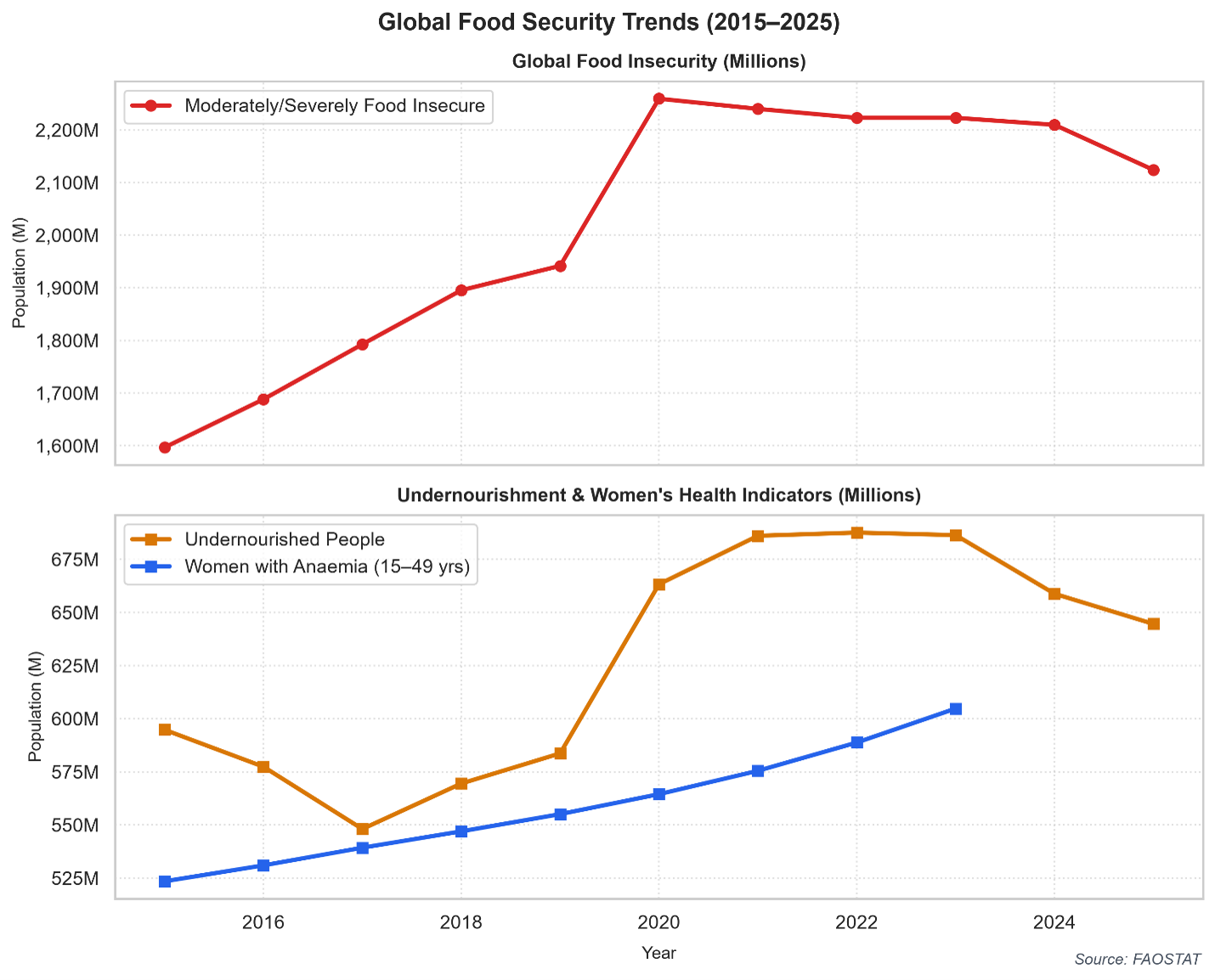
While the gap between the share of men and women facing food insecurity narrowed between 2024 and 2025, the proportion of women facing food insecurity is still slightly higher than that of men.
Food insecurity is highest in poorer countries; for instance, it affects 56% of Africans. But ordinary people in rich countries are also increasingly facing food insecurity. In North America and Europe, nearly 100 million people, or 1 in ten, are food insecure.
Healthy food is unaffordable for a third of the global population
Having food to eat is one thing, and affording a healthy meal is another. A lack of healthy meals costs lives, leads to preventable diseases, and costs economies. For children, it has lifelong impacts on well-being, health, educational outcomes, and lifetime earnings. Globally, 2.7 billion people cannot afford a healthy diet.
Food is more expensive in poor countries than in rich ones
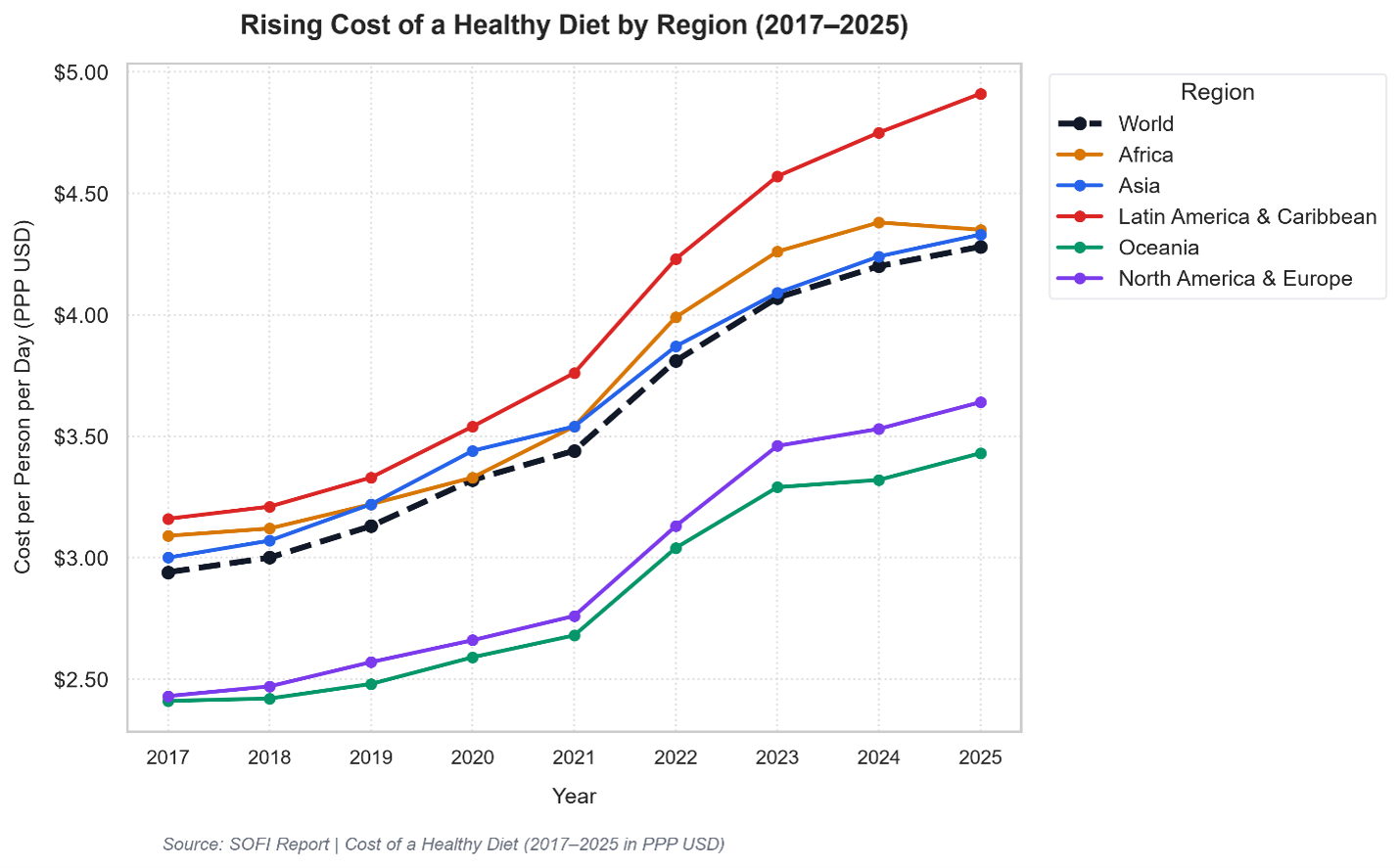
The cost of a healthy diet has risen sharply over the past few years and is 37% up compared to 2019. Higher food prices disproportionately affect ordinary people and low-income earners because food makes up the largest share of their incomes.
Food costs more in poorer countries than in rich ones. In Africa, a healthy diet costs a fifth more than in Europe and North America. This means that people in poor countries not only have lower incomes, but they face higher food costs than those in rich countries.
The world is producing enough food, so why are billions hungry?
Hunger is a problem of inequality, not of overall levels of available food. Farmers are producing enough food for everyone in the world. However, rising food prices, the financialisation of global food markets, low and stagnating incomes, unfair global trade rules, and weak social protection systems mean hundreds of millions of people cannot afford it, even when it’s available. Wars, export bans, and a lack of basic infrastructure to move food from farmers to consumers hinder access. As much as 20% of the food produced goes to waste.
Climate change is making food production more expensive and impacting farmers’ livelihoods. Dismal public investment in food security in poorer countries adds another layer that perpetuates food crises, leaving them at the mercy of the global food system.
The people making money out of global hunger
An exploitative global food market and profiteering deliver bumper profits to global multinationals and their wealthy owners.
In 2022, when the world faced high food prices and disruptions to food supply and production that pushed millions into hunger, the food and energy billionaires made a $453 billion windfall, and 62 new food billionaires were created.
Multinationals and the wealthiest people have greater influence over policies and politics than ordinary people, so they can shape global food rules and food production in ways that benefit them.
Looming Food crisis from war, climate and now a super El Niño
A series of shocks are combining to drive up hunger in the next year. The looming El Niño is expected to worsen hunger. Unlike recent El Niños, this one is likely to be the severest in over a century an comes on top the rapidly growing impact of climate breakdown on food production. Excessive precipitation in some regions and severe droughts in others will severely disrupt food production and livelihoods. Yet governments and the international community are doing little, if anything, to avert this looming food crisis.
How to make the world food secure
No one on earth should be hungry. It is the ultimate inequality. Enhancing food production matters, as does ensuring food is accessible and affordable for everyone. So what can we do?
First, we must drastically reduce current high economic inequality and the influence of the richest and other mega corporations on the global food market. A fairer, more equal world is a food-secure one.
Secondly, we must prioritise universal social protection so people have income to buy food. This will also ensure that a failed harvest doesn’t push small-scale farmers into poverty. Low-income earners, women and children will benefit disproportionately. A universal social protection system could even increase food production because farmers can invest in improving their yields.
Thirdly is regulating the global food market, including its financialisation, speculation, and profiteering. Doing so will make food more affordable and accessible and ensure that mega global corporates and traders do not rip off farmers and consumers. On top of this, fair global trade rules will support food security for many countries of the Global South.
Fourthly is increased public investment in agriculture, especially in low- and lower-middle-income countries, many of which are net food importers. But many of these countries face a high debt burden, which transfers money to wealthy lenders while worsening food security as governments are left with nothing. Global support and cooperation in tackling debt burdens is therefore critical.
Lastly, rich countries must fulfil their climate finance commitments, which will help tackle food insecurity in developing countries, which are most vulnerable to climate and food shocks.
Join the conversation on LinkedIn
The conversation doesn’t end when the newsletter lands in your inbox. We’re on LinkedIn sharing ideas, asking questions and bringing more people into the conversations around inequality, power and how we build a fairer world.
Follow and engage EQUALS on LinkedIn — and tell us what you think. We’d love to hear from you.