

If your net wealth is $1,000, it’ll take you about 17 minutes to count it; a little over a day if it’s $100,000; and 12 days if it’s $1 million. It would take Elon Musk, the first-ever dollar trillionaire, more than 38,000 years nonstop to count all his more than $1,200,000,000,000 wealth (his net wealth as of 12 June 2026). His wealth rose by more than $400 billion in just few hours on 12 June 2026.
To contextualise this further, Musk is now $300 billion wealthier than 3.8 billion people in the world. If he were a country and his wealth were the GDP, the one-person Republic of Musk would be the 20th-largest economy in the world. If he were to spend $1 million per day, it would take him more than 3,280 years to exhaust his wealth. One of my friends said that for him losing $10 in one night would be a disaster for him. Feels like a joke, but not for billions of people.
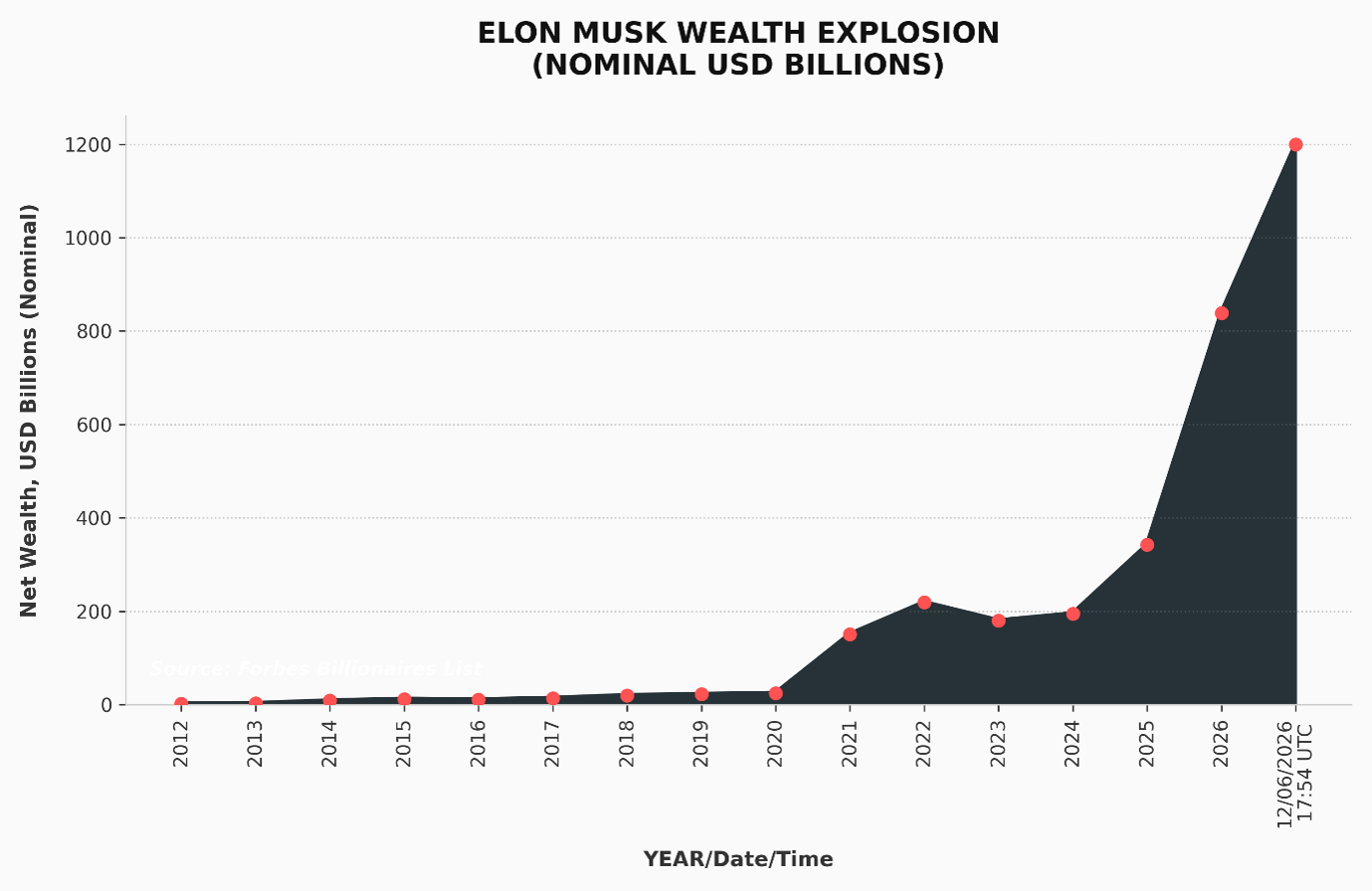
In 2024, my colleagues and I at Oxfam projected that we would see the first trillionaire in a decade. We did not think it would happen quite as fast, but it’s no surprise to those of us who have been following and speaking about the dangerous inequality explosion.
Since the turn of this decade, we have seen a massive concentration of wealth at the top. In nominal terms, i.e. not adjusted for inflation, the world’s billionaires’ wealth is now 2.5 times higher than at the start of 2020, having grown from $8 trillion to more than $20.1 trillion as of 12 June 2026, according to data from the Forbes billionaires list.
Too much wealth and power in a few people
Just imagine what such wealth in the hands of a few people can do to the world. For a start, it can buy influence and political power. Politicians will do your bidding, and government policies can easily be used to appease you. The media – even if not under your full ownership and control (although much of it may be)- will be paying attention to every word you say, and the world will be keenly following it.
That could mean influencing an election in some distant land, sowing division and deciding what people talk about and how. These are not hypothetical examples: seven of the top 10 biggest media companies in the world are owned by billionaires.
No person should have such a massive amount of wealth-it’s too corrosive. Too dangerous.
Trillionaires and extreme poverty in the same world
Even as we get the first dollar trillionaire, the rest of the world is suffering. Globally, nearly 3.8 billion people are living in poverty, 2.3 billion lack enough food, and 3 billion people are facing a housing crisis. And governments are dealing with bankruptcies.
The ongoing war in the Middle East and the closure of the Strait of Hormuz have set food and energy prices soaring, hitting workers and poor people, especially in the world’s poorest countries, the most. Extreme hunger and poverty are expected to rise.
While this is happening, the stock market has hit a record high, further cementing the wealth of the richest. It’s the irony of the world we are living in: too much suffering and too much pain for the majority and too much wealth for a few.
This inequality is because of bad policies
This massive accumulation of wealth is due to bad policies by governments, especially the powerful ones. Mega corporations and their wealthiest owners have enjoyed lower taxes, benefited from deregulation and government subsidies. Musk himself is a big beneficiary of the American taxpayers. This has enabled him to build his empire.
Oxfam’s research shows that about 60% of billionaires’ money is not merited. It has been gained through cronyism, monopoly, and inheritance - these are takers, not makers
It’s a free market for the rest of us and a welfare state for the richest. Nobody should lie to you that billionaires are the most hardworking, most innovative people in the world.
It’s time to tax the super-rich
Tackling wealth accumulation and investing in the common good, like healthcare and decent, affordable housing, is what governments should be doing. It requires decisiveness and bold policy.
A permanent wealth tax on the super-rich can help keep inequality in check, especially if it is designed in a progressive way where the rates paid by billionaires and trillionaires are far higher than for those that are ‘merely’ multi-millionaires or centi-millionaires. A much higher rate of tax would be needed to actually reduce inequality- last week the economist Thomas Piketty recommended a permanent tax on billionaires of 20%.
The money generated from such a tax could mean a lot to billions of people and governments. Just as a thought experiment, a one-off 10% tax on Musk’s $1.2 trillion dollars would raise $120 billion-enough to end extreme poverty in the world for a year. He would still be a trillionaire.
Any wealth tax should be accompanied by other measures, such as regulations to break up monopolies and oligopolies that hinder fair competition and exploit consumers, and stronger protections for workers’ rights.
Finally, governments must set up clear timebound targets to rapidly reduce inequality and monitor progress. They should aim for a Palma ratio of 1 or below- this means the top 10% would not earn more than the bottom 40%. That means that, on average, a person in the richest 10% will still be 4 times richer than someone in the bottom 40%. So far from perfect equality, but much better than today, where the richest 10% can be 5, or 10 times richer than the bottom 40%.
The world cannot afford trillionaires, or indeed billionaires, while the majority of people sleep hungry and tens of millions die from preventable diseases. Governments need to take bold action. And we citizens must demand they do the right thing.
END.
Author: Anthony Kamande is Inequality Research and Policy Advisor at Oxfam International.