

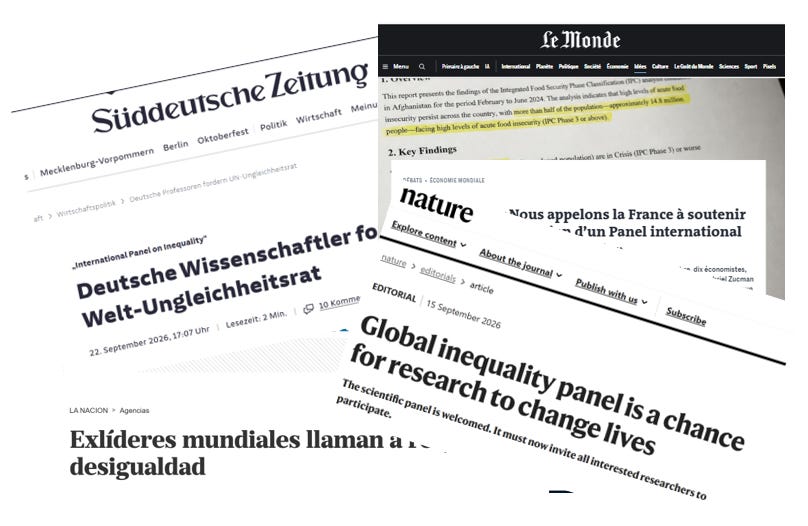
This week saw dramatic progress towards the establishment of a new International Panel on Inequality (IPI). The idea of this panel came out of the G20 in South Africa, and the report prepared for that summit by an Extraordinary Committee led by Professor Joseph Stiglitz. The IPI would do for the inequality crisis what the IPCC does for the climate crisis- build strong scientific consensus on the scale of the problem, its drivers, its consequences and its solutions.
The Fantastic Four
Since then, the governments of South Africa, Brazil, Spain and Norway have joined the original Extraordinary Committee members to lead the fight for this panel. Their leaders: Lula, Sanchez, Ramaphosa and Store all very strongly personally committed to making it a reality. This has gathered momentum all year and took a big step forward in the last few weeks and at the UNGA annual leaders meeting this week in New York.
Academics all agree
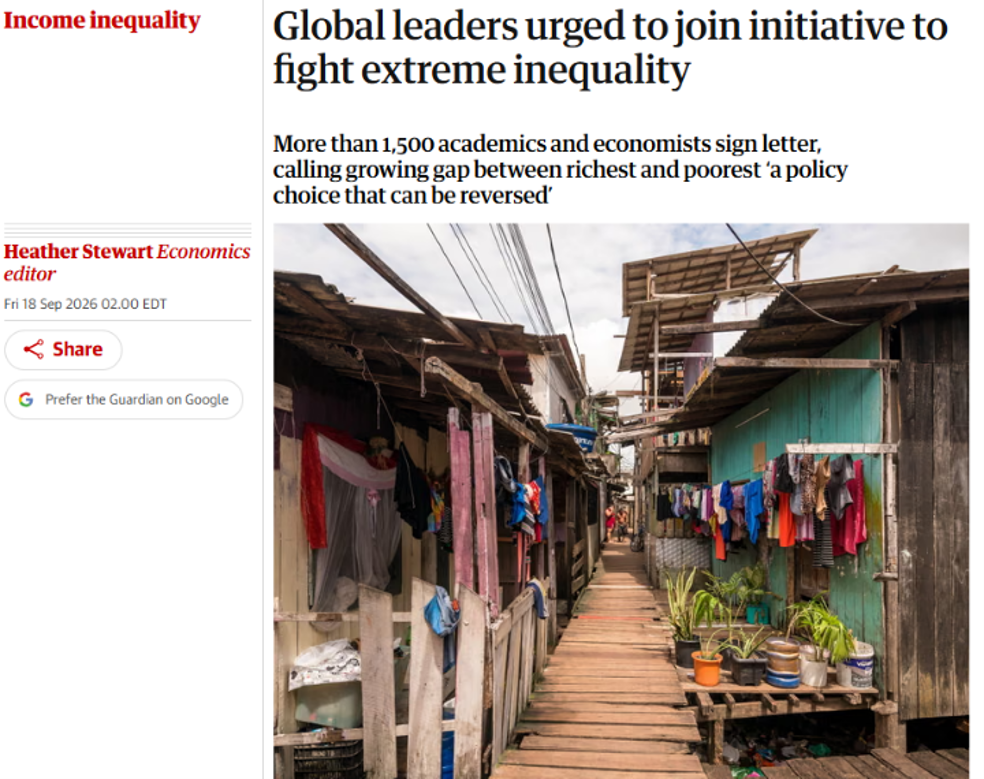
Now that is not a sentence you often read. Yet it does seem that academics from all disciplines agree on the scale and dangers of the inequality crisis and support the urgent establishment of the IPI. Last week over 1500 academics from over 100 countries signed a strong letter in support of the IPI. Academics got together to send their own national letters too in many countries including the UK, Chile, Germany, France and Sri Lanka. Some really famous people signed too- there can’t be many open letters signed by both Jason Hickel and Janet Yellen- that is what you call cross-party support.
Boosted by the BRICS
At the BRICS summit in the second week of September, the inequality crisis was put firmly on the agenda by Brazil and South Africa and figured in the communique: ‘We take note of ongoing high-level discussions on global inequality and we recognize that inequality within and among countries is at the root of most challenges... Expressing our resolve to act in a collective manner and take concrete steps to tackle inequality, we take note of the proposal of South Africa and Brazil to establish an international panel on inequality.’
Former Leaders also in Favour
Last week too thirty-eight former heads of state and government from the Club de Madrid published an open letter in September 2026 urging world leaders to establish the Panel- including Germany’s Olaf Scholz, Ireland’s Leo Varadkar, Nigeria’s Olusegun Obasanjo, Malawi’s Joyce Banda and New Zealand’s Helen Clark.
Current Leaders Concur
All of this was building up to a High-Level event at the UNGA meetings in New York yesterday, Wednesday 21st of September. All UN member states were invited by the four founding governments to show their support for the establishment of an International Panel on Inequality. The event saw many do this. The Prime Minister of Barbados, Mia Mottley gave a passionate speech in support, saying: ‘Greed is man-made, and therefore, if it is man-made, it can be unman-made’. She was joined by many other countries including Germany, Japan, Bangladesh, Uruguay and Mexico in getting behind the IPI.
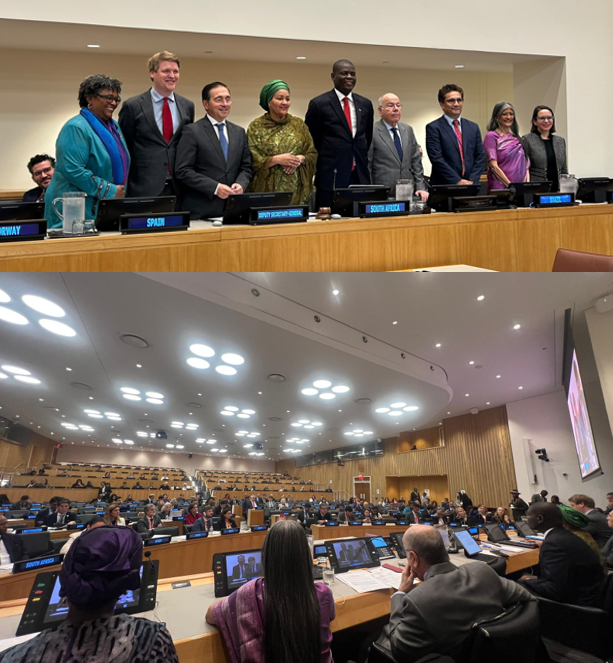
Following this High Level event a big public meeting is being held today in New York with over 200 civil society activists in support of the panel, to plan the next phase of the campaign.
Seeking rapid resolution
The next steps are to continue to build the Panel, which will be under the United Nations University, and simultaneously work to build wide support for the IPI from UN member states for a resolution to be passed by the UN General Assembly. This resolution will give the Panel a strong mandate to produce analysis and evidence for all governments and policy makers, to help them take the actions needed to end the inequality crisis.
Some hope when it is in short supply
This will clearly not be an easy thing to achieve in today’s fractious and fearful multilateral system. The UN itself is under attack, and it is understandably hard to get nations to look beyond their national interest in a world of bullies and belligerents. Nevertheless, this week the International Panel on Inequality came significantly closer to becoming a reality- a glimmer of hope and cooperation in a very dark world.
ENDS
EQUALS podcast is back! Season 9 kicks off with Branko Milanovic exploring one big question: Is neoliberalism dead? Listen now.
