


The ongoing humanitarian, geopolitical and climate crises lay bare the human cost of fossil fuel dependence. Fossil fuel imperialism and energy supply chains have long been a driving factor in conflicts. The brunt of the human cost is borne by those on the frontlines of the conflicts — entire families killed, displaced, and stripped of their livelihoods.
As the conflicts in recent weeks have shown, fossil fuel dependence also triggers energy access disruptions and price shocks that disproportionately affect poor households and marginalised communities across the world, who are struggling to afford their bills. Meanwhile, super-rich individuals and corporations reap huge profits from fossil dependence, consolidating power and wealth. These are the true colours of climate inequality.
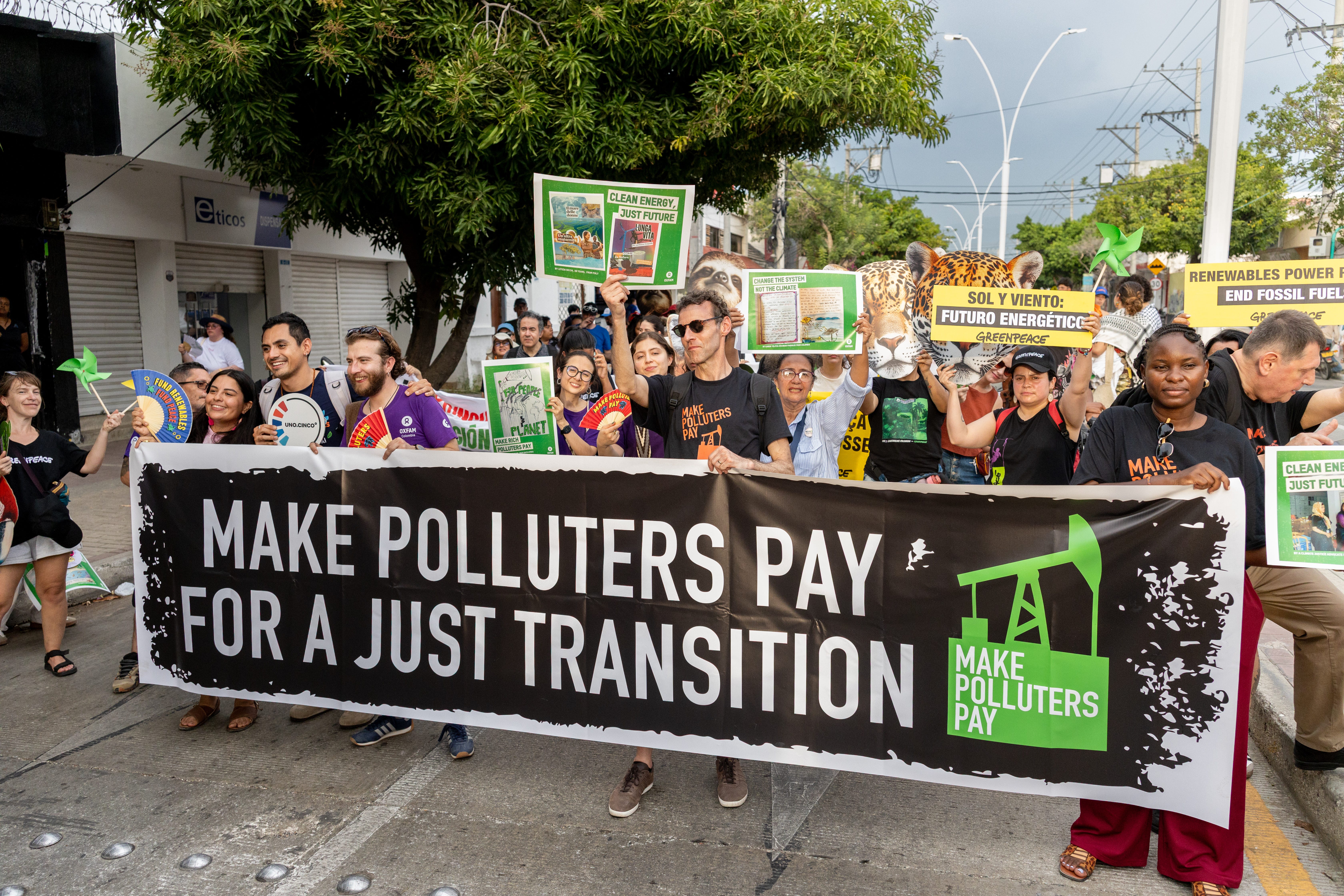
But an alternative exists. A just transition away from fossil fuels to renewable energy is possible, viable and can reshape how societies are organised around energy. It could break the cycle of dependency, inequality and violence.
A truly just transition must go beyond replacing fossil fuels. It must reshape who owns, controls, and benefits from energy, ensuring it is treated as a public good and a human right, rather than a source of profit, power and securitisation.
Humanitarian crisis and Iran: when energy becomes a weapon
The unlawful war waged by the United States and Israel against Iran has killed at least 3,636 people in Iran, including 254 children. Up to 3.2 million Iranians have been displaced from their homes, and strikes have damaged 763 schools and 334 health centres.
A deeply concerning trend is the growing instrumentalization of energy and fossil fuel dependency. Energy infrastructure has been targeted throughout the conflict. More than 80 energy facilities have been attacked since the war began, with damage estimated at up to $58 billion. After Israel bombed facilities in Iran, Tehran responded with strikes on the infrastructure of Saudi Arabia, Qatar, Kuwait and the UAE. Inside Iran, communities already under strain have been left enduring daily blackouts.
The war is also burning carbon at a devastating rate. In just 14 days, the conflict generated over 5 million tonnes of CO2, draining the global carbon budget faster than 84 countries combined. And yet, the war is dismantling energy security across the region and could divert around $25 billion into rebuilding fossil fuel infrastructure, repairing the very systems that drive instability, instead of investing in an energy transition.
The closure by Iran of the Strait of Hormuz— which carries around 20% of the world’s crude oil — and the US stopping ships from entering or exiting Iranian ports triggered what the International Energy Agency (IEA) has called the greatest disruption to global oil supply in history.
Because of its reliance on Gulf oil, Asia has been hit hardest: the Philippines declared a national energy emergency, Pakistan announced school closures and homework for half of all public officials to save fuel. In Sri Lanka, fuel prices have risen 33 percent, with food costs possibly climbing up to 15 percent, as fertiliser supply chains also collapse in Hormuz.
The IEA reported more than 32 governments implementing extraordinary energy conservation measures and nearly 50 introducing emergency consumer support. Public budgets are once again being stretched to carry the weight of fossil fuel dependency, subsidising the profits of the corporations driving this crisis.
Venezuela and Cuba: fossil fuel reconfiguration without human recovery
When the US military seized Venezuelan President Maduro at the start of 2026, Trump made one motive clear: U.S. companies would develop Venezuela’s oil reserves and salvage oil revenue. Venezuela holds the world’s largest proven oil reserves, according to OPEC: 300 billion barrels or 17 percent of the global total.
Shares of some fossil fuel giants rose between 3-6 percent immediately after the military operation. In April 2026, fossil fuel companies moved to expand their presence in Venezuela, signing deals that included asset swaps and new rights to develop oil fields.
Meanwhile, ordinary Venezuelans still struggle every day to make ends meet. In late March, eight-hour power cuts returned, underscoring that access to reliable electricity and basic services remains fragile. Rising oil production cannot offset years of grid underinvestment, while the intensifying dry seasons and climate shocks continue to strain hydropower, which supplies 77% of electricity.
Nearly 8 million people still require assistance in the country, yet humanitarian response capacity has sharply declined. This gap reveals a critical risk: economic reconfiguration without human recovery.
Cuba tells a parallel story. In January 2026, the U.S. administration moved to severely limit oil shipments to the island. Venezuela had been Cuba’s primary oil supplier for decades, a lifeline now cut off. Cuba’s national electric grid reliant on fossil fuel, collapsed in mid-March.
Blackouts forced hospitals to suspend operations and schools and businesses to close. Shortages of cooking gas, gasoline, and diesel strained transport, food supplies, and water pumps. Once again, it is the poorest who pay the highest price.
Fossil Industry: crisis profiteering
Six of the world’s biggest fossil fuel companies — Chevron, Shell, BP, ConocoPhillips, ExxonMobil and TotalEnergies — are projected to earn $3,000 a second in profits in 2026, according to Oxfam research. That is an increase of $37 million a day compared to their 2025 profits. Their projected profits for 2026 stand at $94 billion: enough to provide solar power for the energy needs of almost 50 million people in Africa.
A large share of those profits flows directly to the wealthiest 1 percent — concentrated in the Global North — who profit from the climate destruction these corporations cause, while working to maintain fossil dependence through their monopoly on wealth and political influence.
Yet rather than investing those profits in the transition, these corporations are doubling down on fossil fuels. ExxonMobil announced a reduction of a third of its planned investment in low-carbon energy projects, while TotalEnergies refused to adopt a net-zero transition plan aligned with the 1.5° degrees Celsius target.
The fragility of fossil fuel dependency
Fossil fuel dependence makes energy markets fragile. When wars disrupt supply routes or damage infrastructure, prices surge, supply tightens, and the burden falls on ordinary people through higher energy bills, rising food prices, inflation, and deepening poverty. In 2022, as a ripple effect of the war in Ukraine, energy and food price shocks pushed over 70 million people into poverty in just three months.
For oil-producing countries, dependence on revenues from fossil fuels exposes economies to volatility and external interference. For consuming countries, reliance on imported fossil fuels creates exposure to price shocks and geopolitics.
African countries such as South Sudan and Zimbabwe illustrate this vulnerability. South Sudan, home to East Africa’s largest oil reserves, still imports most of its fuel due to a lack of refining capacity, and generates 96 percent of its electricity from oil. During the Hormuz crisis, power cuts in the capital Juba lasted up to 12 hours a day, paralysing businesses and daily life.
Zimbabwe, reliant on fossil fuel imports, began diluting petrol with ethanol and announced plans to scrap fuel taxes to ease prices. However, this measure has its own distributional challenges: ethanol blending does not necessarily reduce transport costs for consumers. While locally produced ethanol is untaxed, potentially easing prices, it can also reduce government revenue and concentrate benefits among a few large, wealthy producers.
The resilience of renewable energy
Renewable energy offers a more secure, resilient, and equitable alternative. Decentralized systems such as solar and wind are less vulnerable to targeted attacks, quicker to repair, and support grid stability during emergencies, as seen in Ukraine. They do not rely on continuous extraction, processing, and long-distance transport through fragile supply chains. Once deployed, renewables are locally available resources, reducing exposure to geopolitical shocks.
Renewables offer more stable costs, shielding households from the extreme price volatility, especially during conflicts. During the Hormuz crisis, electricity prices rose across Europe, but significantly less in Spain due to lower gas dependence. The country generates about 57 percent of its energy from renewables. Solar, wind, and hydro complement each other across seasons and times of day, reducing the need for gas as the backup source.
Renewables can shift power away from concentrated ownership by enabling decentralised, locally distributed generation that strengthens community resilience. Lebanon has shown the strong potential of decentralised renewable energy, as the recent economic crisis drove thousands of households and businesses to adopt solar power to provide essential services, such as water pumping. However, this transition was mired with inequalities in access, with poor households and marginalized communities unable to reap the same benefits. Lebanon’s energy potential was also harmed by Israel’s relentless military campaign which has also targeted solar panels, as it was done in Gaza, showing the limitations of resilience against such systematic destruction.
The Path Forward: Transitioning Away from Fossil Fuels
The energy transition is not only about reducing emissions. It is about addressing one of the structural drivers of inequality, humanitarian crisis, and violence: fossil fuel dependence.
A just transition also depends on reforming the international financial architecture, which currently strangles the fiscal space in the Global South and tightens further during war and crisis. This drives debt burdens that can lock developing countries into fossil fuel dependency and constrain climate action. Global North countries must not only move first and faster but also enable the Global South to do the same.
A just and accelerated transition away from fossil fuels towards renewable energy offers a shared path forward. It can reduce emissions, ease geopolitical tensions tied to resource extraction and control, and strengthen energy access and security for communities. Most importantly, it can help build a fairer system in which the benefits of energy are more equitably shared, rather than concentrated among a few.
Author: Mateo Adarve Zuluaga is the Global Research and Advocacy Lead at Oxfam Great Britain.
For more on the political economy of war, oil, and inequality, listen to our recent EQUALS podcast conversation with Adam Hanieh.
War, Oil, and Inequality: Who Wins and Who Loses

In this episode, Adam Hanieh explains why crises like war, financial shocks, and pandemics don’t stay where they start. They move through the structures of the global economy.