


UPDATE: The Q2 profit figures have now been released for all the companies showing their combined profits increased to $50.6bn - a 220% increase on Q1!
A major new investigation by Equals reveals how fossil fuel corporates have reaped huge windfall profits following the US and Israel war against Iran. It also highlights the impacts of their carbon emissions on extreme heatwaves and outlines the revenue potential for a ‘rich polluter profits tax.’
Exclusive new analysis of Big Oil reveals that:
Their 2026 second quarter (Q2) profits are expected to nearly double, compared to the first quarter (Q1). Corporate polluters like ExxonMobil are making up to $1,800 a second.
They are forecast to make more profit this year than the previous 21 months combined.
Their emissions sufficient to cause around 1 in 4 heatwaves reported globally between 2000 and 2023 – heatwaves that would have been virtually impossible without human-made climate change.
They plan to increase oil and gas production by 14% by 2030, the equivalent of producing an additional 2.5 million barrels of oil a day.
A ‘rich polluter profits tax’ could raise up to $400 billion and help phase out fossil fuels.
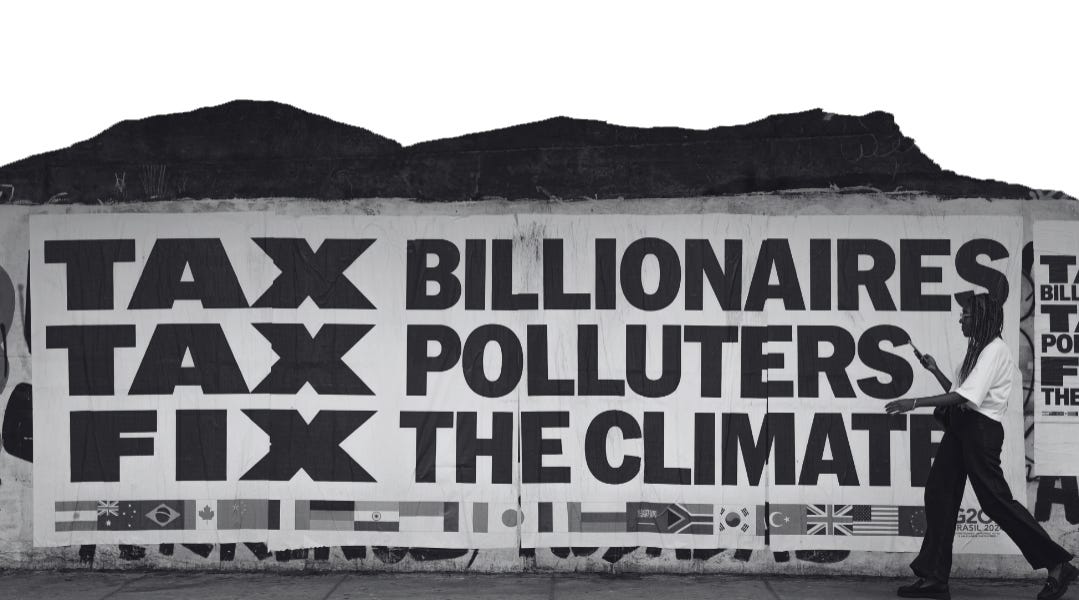
Equals Investigates...Big Oil profits
Windfall war profits. The six Big Oil corporate: BP, Chevron, Eni, ExxonMobil, Shell, and TotalEnergies, will publish their Q2 financial results over the coming week. Equals’ new research, based on financial analysts’ projections, finds that, overall, their Q2 net profits are expected to have almost doubled in the last three months (compared to Q1 profits) from $23 billion to $45 billion. Q2 results fully reflect the spike in oil prices following the unlawful US and Israel war against Iran.
Bumper profits for US corporations. The two corporations headquartered in the US are expecting especially massive windfall profits. Chevron’s Q2 profits are predicted to be over four times higher than in Q1, while ExxonMobil’s profits are forecast to more than triple.
ExxonMobil has made $1,800 a second in profits during the last three months. Chevron has pocketed $1,200 a second, and Shell $1,000.
The war against Iran has driven bumper profits for major oil and gas corporations. In 2026, the six Big Oil corporations are expected to make $147 billion, more than their combined profits over the 21 months from Q2 2024 to Q4 2025.
Profits driving inequality and the climate crisis. Big Oil’s windfall profits are being used to drill for even more planet-destroying fossil fuels and to enrich wealthy shareholders.
Shareholder payouts. In 2025, the six corporations paid out a total of $55 billion in dividends and $62 billion in share buybacks, which went to line the pockets of shareholders who are predominantly the world’s richest people.[i] In the US, the richest 1% own more corporate shares than the other 99% of the population combined.[ii] 85% of people globally are “capital destitute” (i.e. they get no income from financial assets).[iii]
Bumping up production. By 2030, the six corporations plan to increase oil and gas production by 14% compared to 2024 levels, equivalent to producing an additional 2.5 million barrels of oil a day.[iv] Just a 6% increase in global oil and gas production could lead to a 2.9º C increase in global temperatures by the end of the century.[v] In 2025, major oil and gas companies BP and Shell cut their targets for future low carbon investments by 73% and 37% respectively.[vi]
Emissions adding fire to heatwaves. Analysis of peer reviewed data[vii] finds that, of the 213 heatwaves recorded between 2000 and 2023, 55 would have been virtually impossible without human-induced climate change. The historical emissions of Chevron, BP, ExxonMobil, Shell, and TotalEnergies (data for Eni not available) were, on their own, enough to cross the threshold that made nearly all those heatwaves over 10,000 times more likely (50 heatwaves for TotalEnergies, 51 for the four others). This means that the emissions of any of those five companies were enough, on their own, to cause around 1 in 4 of the heatwaves.
Costing the world. The same research shows that the emissions of 180 largest carbon majors (fossil fuel and cement producers) contributed to roughly half of the increase in global heatwave intensity since pre-industrial times. The five oil corporations alone account for 8% of this increase in intensity. Their contributions to global warming, as a whole, was about 0.1°C (6.5%) in 2023 and caused about 8% of global warming between 2000 and 2023.
Massive direct emissions. In 2025, BP, Chevron, Eni, ExxonMobil, Shell, and TotalEnergies reported emitting a combined 358.3 million tonnes of scope 1 and 2 CO2e emissions from their operations (this doesn’t include their supply chain or customers). This is equivalent to the annual emissions of 55 million people. The estimated direct and indirect environmental damage costs, calculated by translating the quantity of resources used and pollutants emitted into monetary terms (using S&P Capital Trucost figures) $60 billion in 2025.
Disasters across the world. Big Oil’s quarterly profits come as record-breaking temperatures sweep across Europe and North America — extreme heatwaves that climate scientists warn would have been virtually impossible without the climate crisis driven by burning fossil fuels.[viii]
India and Pakistan have also faced sustained extreme heat in 2026. In May, 97 of the 100 hottest cities in the world were in India.[ix] Ghana, Nigeria, Ivory Coast and other West African countries are experiencing devastating flooding.
The worst is likely yet to come. A “Godzilla El Niño” is forming over the Pacific Ocean which is forecast to drive global temperature to record highs, bringing with it extreme weather events. Poorer communities, already vulnerable to climate impacts, are bracing themselves for extreme heat, droughts and floods. The UN’s World Food Programme is appealing for funds for drought-resistant seeds, flood defences, water storage systems and cash transfers to avert a global hunger crisis before it happens.[x]
Compounding global crises. Global crises are compounding, each piling onto the last. There is a global debt crisis: half of low-income countries are “at high risk of debt distress” or “in debt distress”.[xi] At the same time, official development assistance has been gutted, with aid has falling by 28% between 2023 and 2025[xii]. With food and energy prices already out of reach, those already vulnerable to extreme weather events are left even more dangerously exposed. Many countries are poorly prepared for the unfolding crises ahead.[xiii]
Rich countries derailing progress. Against the backdrop of compounding global crises, last month’s essential Bonn Climate negotiations, which sets the groundwork for COP31, were derailed by rich countries.[xiv] Negotiations to scale up cuts to global emissions and fund climate adaptation faced “gridlock.”[xv]
Case for rich polluter profit tax. Oxfam has modelled a ‘rich polluter profit tax’[xvi] which could raise up to $400 billion globally in its first year (based on 2024 figures), comparable to the estimated $290 billion to $1.045 trillion needed annually by 2030 to pay for the loss and damage caused by climate change in the Global South. This type of tax would be permanent, unlike one-off ‘windfall profit taxes’.
Political momentum for taxing rich polluters is building. Finance ministers in Italy, Germany, Spain, Portugal and Austria have called for a new windfall tax on energy profits[xvii]. In Australia, where Oxfam research found that one in three coal, oil and gas corporations are paying no corporate income tax[xviii], the government is considering options to tax the windfall profits from liquefied natural gas.[xix]
Our research into the positions of 60 countries finds that 28% have implemented a temporary windfall tax on excess profits from fossil fuel companies, with a further 13% supportive. Just 12% are explicitly against the move.[xx] Most countries that recently supported windfall taxes on fossil fuel producers/energy companies did so in response to energy price surges following the Russian invasion of Ukraine.
Rich polluters must be made to feel the heat. Not us.
The full methodology note for the research is here.
Note: the calculations were based on estimates made before TotalEnergies’ Q2 profit announcement on 23 July 2026. For the corporation’s second-quarter results, see its website.
[i] Eni has significant state ownership
[ii] https://fred.stlouisfed.org/release/tables?rid=453&eid=813804&od=# Share of Corporate Equities and Mutual Fund Shares in Q1 2026 Top 1% held 50.2%
[iii] https://blogs.lse.ac.uk/inequalities/2025/09/17/new-capitalism-in-america-part-iii/
[iv] Oxfam analysis based on https://www.transitionpathwayinitiative.org/publications/uploads/2026-transition-planning-2026-decarbonisation-strategies-in-oil-and-gas-and-diversified-mining.pdf
[v] https://www.iea.org/reports/world-energy-outlook-2025
[vi] https://www.ft.com/content/ce4da4e0-192a-494a-a1a7-bea940b146f3
[vii] https://www.nature.com/articles/s41586-025-09450-9
[viii] https://www.worldweatherattribution.org/fossil-fuels-are-heating-americas-250th-birthday/ https://www.worldweatherattribution.org/fossil-fuel-emissions-have-rapidly-worsened-european-heatwaves-in-just-a-few-decades/
[ix] https://www.msn.com/en-in/news/India/97-of-world-s-100-hottest-cities-in-india-why-balangir-banda-are-out-boiling-sahara-and-death-valley/ar-AA23OLGN?cvid=6a10edaccd5c4857b7409a05f90afb88
[x] https://www.wfp.org/news/bracing-el-nino-fao-and-wfp-launch-joint-appeal-protect-88-million-people-extreme-weather
[xi] https://www.equals.ink/p/default-on-debt-not-on-development?utm_source=publication-search
[xii] https://www.equals.ink/p/rich-countries-turn-their-back-on
[xiii] https://www.equals.ink/p/rich-countries-turn-their-back-on
[xiv] https://www.oxfam.org/en/press-releases/oxfam-reaction-2026-bonn-climate-negotiations
[xv] https://unfccc.int/news/written-statement-of-unfccc-executive-secretary-on-closing-of-un-june-climate-meetings-sb64
[xvi] https://www.oxfam.org/en/blogs/rich-polluter-profits-tax-could-raise-400-billion-and-help-phase-out-fossil-fuels
[xvii] https://www.politico.eu/wp-content/uploads/2026/04/04/Letter.pdf
[xviii] https://www.oxfam.org.au/blog/freeloaders-how-gas-corporations-are-paying-little-tax/
[xix] https://www.theguardian.com/australia-news/2026/jul/03/australia-gas-tax-lng-exporters-predicted-windfall
[xx] https://docs.google.com/spreadsheets/d/1aocqBrvMKJJeF-F5hyKFnVWa2Pv8IHwH/edit?gid=798616290#gid=798616290
Where did you get the tax the billionaires photo? Is it copyright free?