


Since the World Economic Forum opened at Davos this week, billionaires have already made $24bn – that’s enough to build either a luxury underwater city OR pay for 198,739 additional nurses (among many other things) if the world’s poorest countries had this additional revenue, according to Oxfam’s new billionaire wealth tracker.
This year’s Oxfam inequality report sets out how 2025 has been an absolutely bumper year for the super-rich. The number of billionaires has surpassed 3,000 for the first time, and billionaire wealth is now higher than at any time in history. Meanwhile, one in four people globally face hunger.
The core message of the report is about how the super-rich buy political power and erode the rights of the many. We’ll cover that part of the report in next week’s Bulletin, so remember to subscribe if you’re not already.
This week, we’re focusing on section 1 of the paper, the great inequality divide.
A new episode of the Equals Podcast has just gone live
The great inequality divide…in numbers
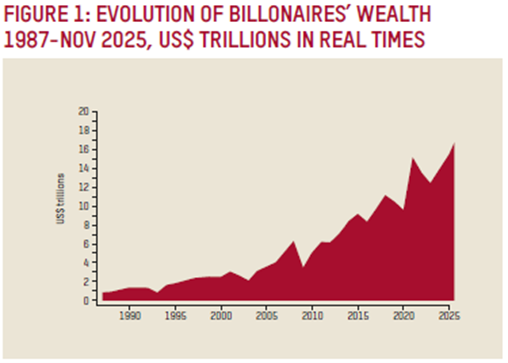
A great decade for billionaires. 2025 was another record-breaking year for billionaires. For the first time, their number reached 3,000, and as of November 2025, their wealth reached a new high of $18.3bn. Since Donald Trump came to office, their wealth increased three times faster than the past five-year average. Trump’s agenda of championing deregulation and undermining agreements to increase corporate taxation has benefited the richest everywhere.
Mega time for millionaires. In 2024, more than 680,000 dollar millionaires were created globally, with 5.34 million new millionaires projected over the next five years. The poorest half of humanity holds just 0.52% of the world’s wealth, while the richest 1% own 43.8%
Meanwhile, billions face poverty and hunger. One in four people globally face hunger, increasing by 42.6% between 2015 and 2024. 92 million food-insecure people live in Europe and North America, some of the richest regions in the world.
Since 2020, poverty reduction has largely ground to a halt, with poverty rising again in Africa. In 2022, nearly half of the world population (48%), or 3.83 billion people, lived in poverty. If current trajectories hold, 2.9 billion people, or a third of the global population, will still be living in poverty in 2050.
A small redistribution of wealth would be enough to prevent this injustice; just 65% of billionaires’ wealth gained over the past year would end global poverty (at US$8.30 per day).
Rising debt and aid cuts leave a trail of destruction. Many countries in the Global South are grappling with a profound debt crisis driven by high interest rates and worsening economic conditions. 3.4 billion people live in countries that spend more on interest payments than on education or health. In Africa, spending on debt servicing is 150% greater on average than the combined spending on education, healthcare and social protection. Cuts to aid budgets have directly hit people living in poverty and could lead to more than 14 million additional deaths by 2030.
Vital public services made unaffordable and inaccessible. Currently, 2.8 billion people around the world lack adequate housing, with 1.12 billion living in slums and informal settlements. In low-income countries, 33% of school-age children and young people are out of school, and across low- and lower-middle-income countries, children in the least wealthy 20% are four to five times more likely to be out of school than those in the richest 20%.
Essential public services are not only woefully underfunded – they are being corroded by policies and narratives shaped by super-rich corporate interests that erroneously position the private sector as more efficient.
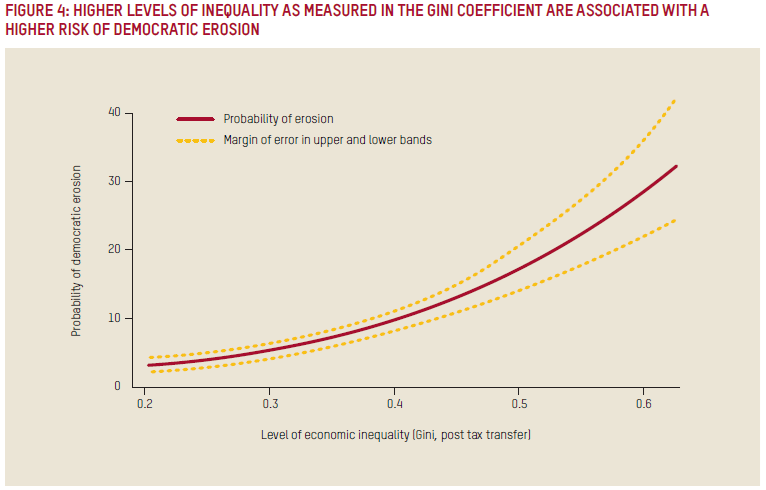
Economic inequality leads to political inequality. When a billionaire buys a politician, a newspaper or impunity from justice, it gives them tremendous influence over all our futures, undermining political freedom and eroding the rights of the many. Rising inequality leads to a higher risk of democracy being undermined, and that inequality is one of the strongest predictors of democratic backsliding. The most unequal countries are as much as seven times more likely to see this happen than more equal countries.
More on how the rich undermine democracy, and how to build a more equal future in next week’s Bulletin.
Something to read/listen to
Listen to Equals Podcast, with Gary Stevenson, Citibank trader turned wealth tax champion on wealth inequality, economic failure and why we must tax the rich now
Read Oxfam CEO, Amitabh Behar on ‘How to build a future that benefits everyone’.
Watch some of the best Oxfam campaign videos from this week
Really strong breakdown of the wealth concentration issue. The connection between economic inequality and democratic backsliding is critical - countries with higher inequality being 7x more likely to see democracy erode is a statisic that doesn't get enough attention. I've noticed in my own work that when wealth becomes this concentrated, policy discussions shift from 'what's best for society' to 'what preserves the current structure,' which is insidious.