


When Oxfam published its first climate inequality report in 2020, it was barely recognised that inequality was at the core of the climate crisis. Today policy makers recognise that it’s not just rich countries but rich people who bear a disproportionate responsibility for the climate crisis.
Oxfam’s latest research shows how the super-rich are directly contributing to climate disasters. They can insulate themselves from these disasters and, most worrying, profit from climate breakdown.
In this two-part series, we break down the findings of Oxfam’s new report “Disaster Divide: How Climate Chaos Deepens Inequality and Enriches the Few.”

Disaster Divide, in numbers
First, the latest research on emissions inequality. The richest 8 million people emit more carbon than the poorest 3.5 billion people combined. They emit more than three times as much as the entire population of sub-Saharan Africa (1.3 billion people) and 37 times more than all carbon capture and storage plants remove in a year.
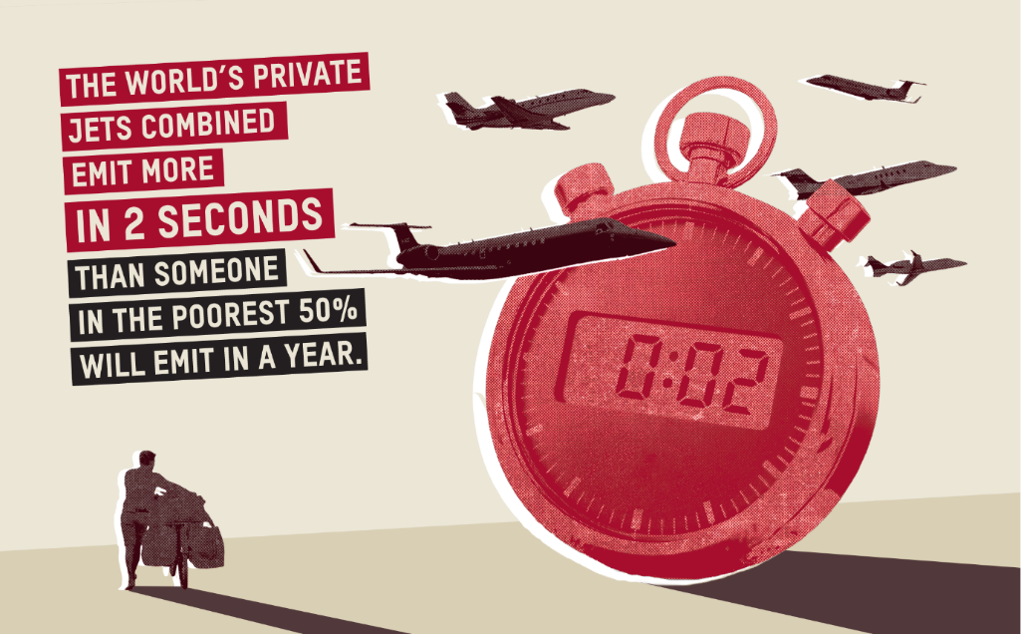
Sky-high emissions. There is perhaps no better symbol of the wasteful carbon emissions by the richest people than travel by private jet. In 2025, each flight caused 3.7 tonnes of CO2 on average – around what an average person will emit in a year. In total, the jets covered 4 billion kilometres, equivalent to circumnavigating the world 105,000 times. 68% of private jets departed from the US, despite just 4% of the world’s population living there.
Following the money. Oxfam tracked the investment portfolios of 1,000 billionaires and found that their investment emissions totalled 486 million tonnes of CO2e in 2025, equivalent to being the 19th most-polluting country in the world, just after Australia and ahead of South Africa. Most importantly, the research finds that billionaires’ investments tend to be in highly polluting industries: 71% of their investments are categorized as in “high climate-impact sectors” such as oil, gas or chemicals, compared to 63% of investments in the S&P Global 1,200 (an index covering 70% of the global market value of companies).
The emissions of the super-rich are contributing to immediate climate disasters. By using the latest models on climate attribution, Oxfam’s research found that the richest 0.1% have contributed 125 times more than the average person to the extreme heatwaves we’re experiencing today.
Cashing in on climate disaster. The very people responsible for the crisis are turning chaos into profit. The rich have long made profit from corporations that destroy the planet; now they’re turning their wallets to the global disaster recovery market, forecast to grow from $70 billion to $92 billion a year by 2029.
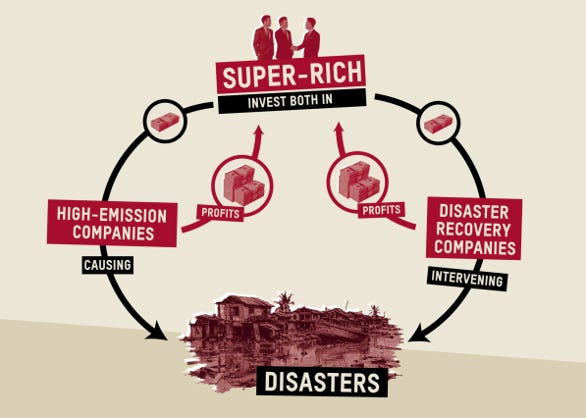
Double disaster dividend. To investigate this trend, Oxfam created the “Destroy and Rebuild” Index, a sample of 217 corporations. It consists of the usual suspects who are fuelling climate disasters, like oil and gas giants, alongside corporations preparing for disasters, like flood defence contractors, or recovering from them, like clean-up companies.
On average, the corporations in the “Destroy and Rebuild” Index made $1.8 billion in profit in 2025, paying out more than $1 billion to their shareholders. Ten asset managers have investments in over 90% of these corporations, with BlackRock and Vanguard invested in 92% of the corporations in the index. The pair’s total investments in these companies exceed $1 trillion.
Disaster capitalism 2.0. It doesn’t stop at cynical profiteering. Disasters have also been used to push through the privatisation of public services and deregulation. In Puerto Rico, for example, Hurricane Maria’s aftermath was used to advance the privatisation of the island’s electrical grid. After Hurricane Irma devastated Barbuda in 2017, reconstruction made way for luxury residences and a golf course on land that included natural coastlines and wetlands.

Something to read/listen to
Read Oxfam’s new report “Disaster Divide” (of course!)
Or if you prefer your reports in 1-minute videos….
Watch this short film from France’s wildfire first responders.
In non-climate news. This excellent blog about what Nvidia’s $235 billion stock buybacks program says about inequality in the AI economy.
Catch up on the latest Equals podcasts

