


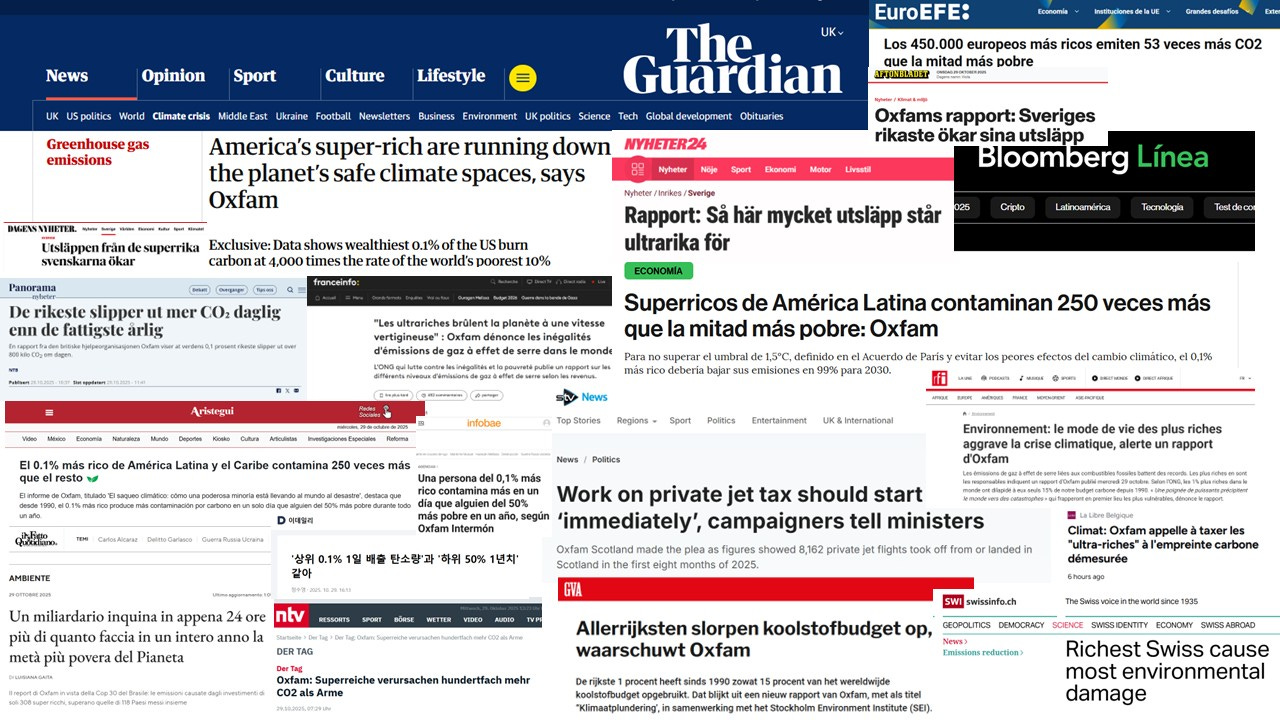
Oxfam’s latest climate and inequality report has been making global headlines ahead of COP 30, which is being held in Belém, Brazil. Using the latest data on the emissions of the super-rich, the report sets out, in stark terms, that it is the world’s richest individuals, wherever they live, who are most culpable for the looming climate disaster.
COP 30 comes ten years after world leaders agreed in Paris to take urgent action to limit global warming to 1.5 °C above pre-industrial levels. Governments have failed to decarbonise their economies rapidly, and it is now almost inevitable that humanity will overshoot the Paris agreement. Hurricane Melissa is the latest devastating weather event intensified by human-caused climate change.
Oxfam’s research, the fifth report in their climate and inequality series, updates the emissions inequality data behind the famous ‘champagne glass’ (below) and explores how the super-rich utilise their economic and political power to lock the world into climate disaster.
This week’s Bulletin looks at the latest emissions inequality data; we’ll release part 2 on the influence of the super-rich during COP in November. If you can’t wait until then, you can read the full report here.
Climate and inequality, in numbers
Passing terrifying milestones. In 2024, average global temperatures exceeded 1.5°C above pre-industrial levels for the first time. The same year, two-thirds of the earth’s surface experienced record temperatures and fossil-fuel emissions reached their highest-ever levels. The evidence that we are facing imminent and irreversible climate breakdown is now damning.
The carbon budget is almost depleted. The best available climate science shows that at the current rate of emissions, there are just two years of available carbon budget remaining. Exceeding the carbon budget means global warming will rise above 1.5 °C.
This fact shouldn’t stop the world from acting out of despair, even when we do exceed 1.5°C, every subsequent fraction of a degree of heating makes a huge difference.
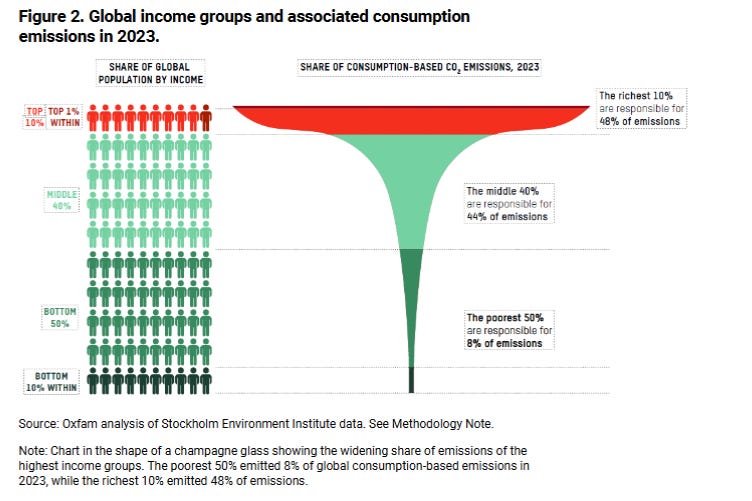
The super-rich are burning through our climate budget. A person in the top 0.1% emits more in a day than a person in the poorest 50% emits all year. The rich are ripping through the carbon budget – if everyone emitted like the 0.1%, it would be gone in 3 weeks - to stay within safe limits, they’d need to cut their emissions by 99%. The climate crisis is an inequality crisis.
Not just rich countries, rich people everywhere. The report is a powerful reminder that it is not just rich countries but rich people who bear the responsibility for fuelling today’s dangerous levels of global warming. The majority of the super-rich live in the Global North, but ultra-wealthy people in poorer nations are also culpable. For example, someone in the richest 0.1% in Nepal, a country with a very low share of historic emissions, emits eight times more than someone in the poorest 50% in the UK.
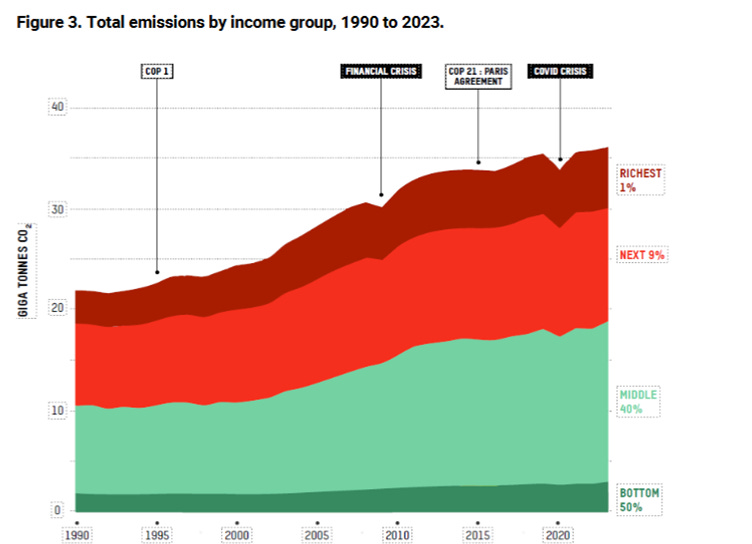
The wrong group is cutting emissions. One of the most shocking findings is that the share of emissions is increasing for the rich, who can most easily reduce their emissions, and decreasing amongst the world’s poorest people. Since 1990, the richest 0.1% have increased their share of total emissions by 32%, whilst the poorest half of humanity has actually seen their share of emissions fall by 3%.
What does this mean for climate policy? The climate and inequality crises are inextricably linked. The same ideologies and power dynamics that are fuelling inequality are allowing corporations and their rich owners to avoid regulation and to keep the world hooked on fossil fuels in the name of profit.
Policies to combat the climate crisis must take into account the responsibilities of the richest people.
Subscribe to receive part 2, where we will look at the political and economic power of the super-rich and how their polluting interest are locking the world into a high-carbon economy. We’ll also go through the report’s recommendations.
Something to read/listen to
Read Oxfam Canada’s new Inequality Scorecard, which assesses federal policies across eight critical areas and exposes the gaps between political promises and meaningful action.
Read Simon Kuper in the FT on Time to guillotine France’s super-rich tax breaks.
Read The World Inequality Lab’s climate and inequality report that focuses on the role of wealth in the climate crisis.
Listen to Ones and Tooze on the winners of the Nobel Prize for Economics.