


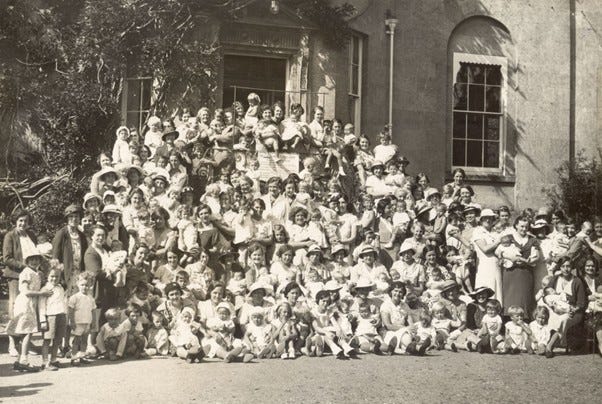
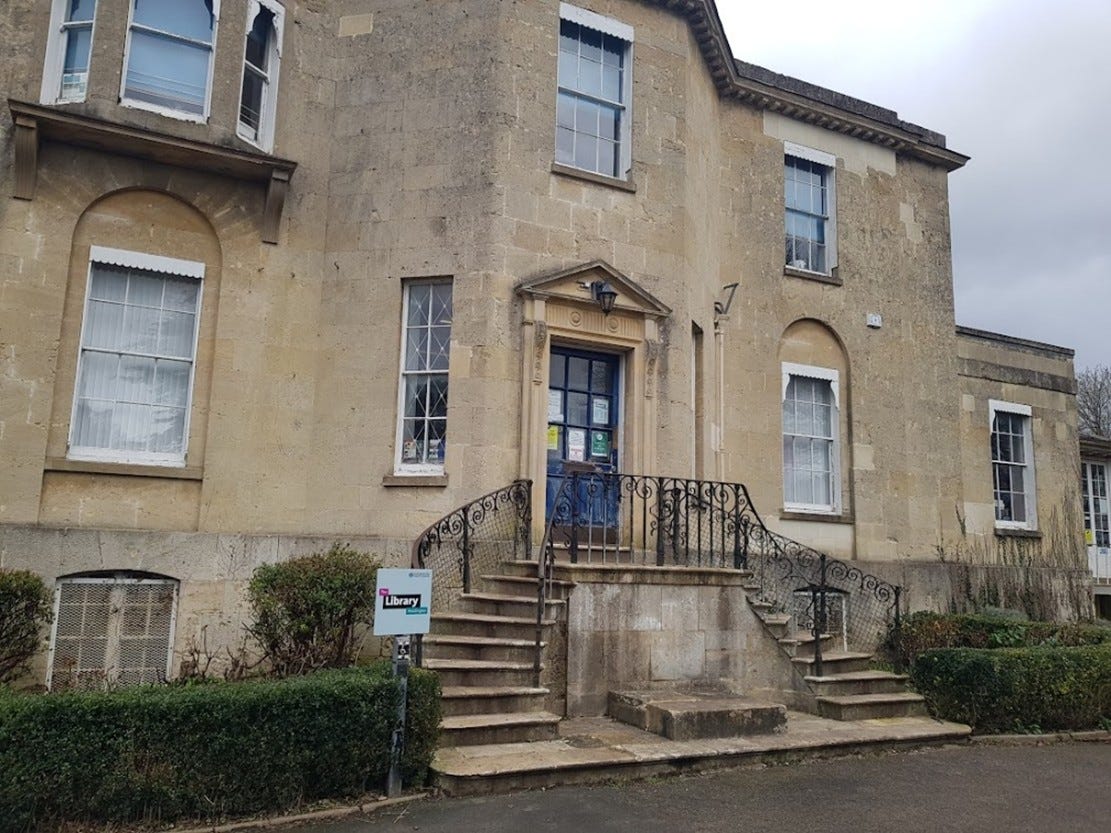
I was staying at my mother’s house in Oxford recently and we went to the local public park with the kids. The park has an old stone house that now serves as the public library. Bury Knowle park and house were originally in private ownership. The house was built for a banker in 1800, and owned by a series of wealthy families, before being bought by the city council in 1930. It was turned into the park and library it still is today, as well as other uses such as being a baby clinic for young mothers.
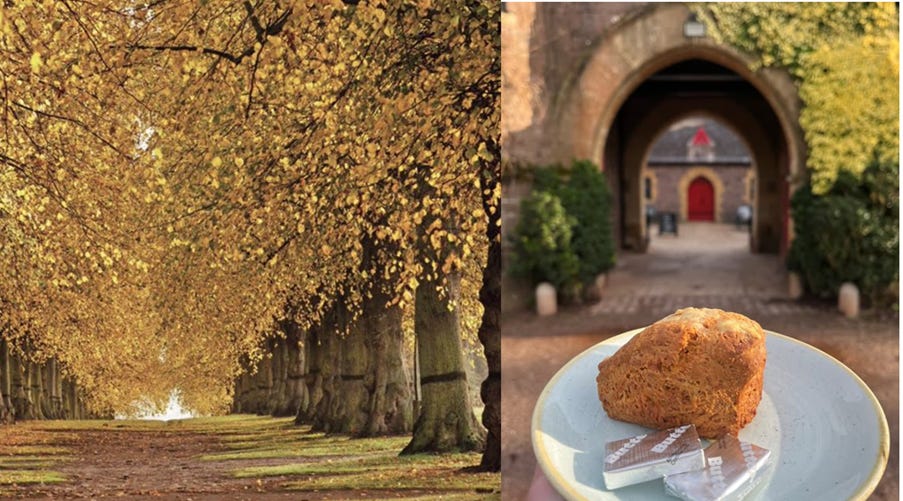
The UK has many such buildings and parks, formerly the large homes of rich people, now run for various government or public purposes- becoming libraries, hospitals, education colleges or various government training institutes. Many hundreds of other large houses and grounds are managed by the National Trust, which is an independent charity, and the public can pay to visit them. These properties are very popular, especially with the middle classes as the cost of entry remains a barrier. I love them, particularly the grounds, as they are generally beautiful landscapes with huge mature oak and other trees, an oasis from the industrial farmland that makes up most of our countryside. Great tea and cheese scones too.
A peaceful revolution
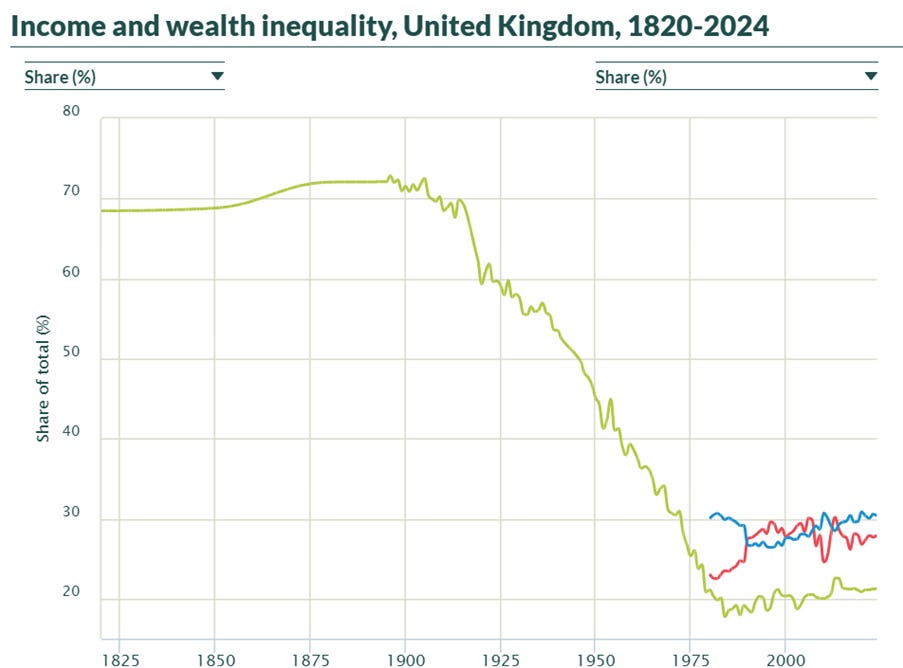
These houses and their transition from private ownership to public use are the very physical manifestation of an incredible reduction in wealth inequality that occurred during the 20th century in the UK, where the share of wealth of the richest 1% fell from a peak of 72% to 18% in 1983.
In addition to many of these houses and their land being turned over to the public, many more were simply demolished, and the lands they controlled divided up. Over a thousand country houses were destroyed up and down the country.
Some of these houses were enormous, similar in size and stature to the fictional Downton Abbey, employing huge numbers of servants and other staff, all to support one family.
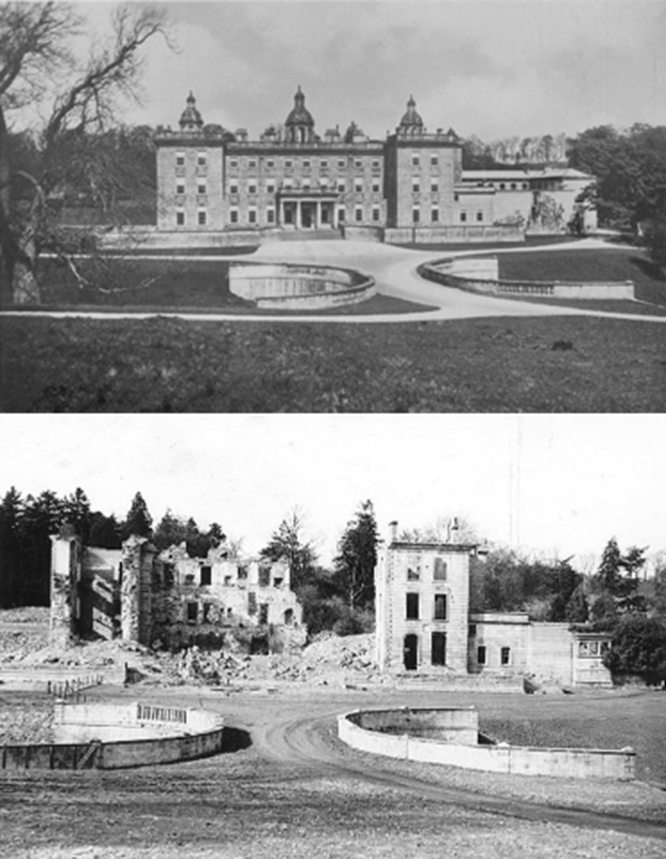
They were torn down, the many books in their libraries and their collections of art sold off, or given to the state in lieu of tax owed- today if you go around the National Gallery and look at the many amazing works of art, next to the name of the picture, you often see a short sentence saying, ‘donated to the nation by Lord X, in lieu of death duties’.
This radical shift was not the result of a violent revolution or insurrection, but the product of a peaceful, democratic transition that took the UK from being one of the most unequal countries in the world to being one of the most equal, on a par with Sweden. It is a story that is not well know at all and rarely told.
The reasons behind this dramatic destruction of privilege and great fortunes were multiple, the product of both deliberate policy and historical events, and the complex synergy between them. They have, I think, significant implications for today, where wealth is once again becoming far more concentrated in the UK and the rest of the world.
The purposeful destruction of extreme wealth
While peaceful and democratic, this shift did not happen without a fight. This was a dramatic battle between the newly enfranchised, newly organised and vocal working and middle classes, and the historically wealthy, many of whom could trace their wealth back to the Norman conquest of Britain.
The removal of trade protections on corn, and the competition from corn grown in the USA or Argentina, made farming less profitable, and not enough to support such palaces and the style of living that came with them.
Taxes on wealth, inheritance and incomes, played a huge role in this demolition of wealth. The ‘supertax’ introduced on the incomes of richest by the Prime Minister Lloyd George, who faced a huge battle to do it with the House of Lords. The estate tax, known also as ‘death duties’, which was introduced in 1894, reached a peak of 85% in the 1960’s.
The first World War saw many young men who were the heirs to fortunes killed on the battlefield, mown down by machine guns, leading their men over the top. It also saw many servants go to fight, and many houses temporarily requisitioned to become hospitals. Many did not come back either, over 720,000 were killed in WW1, around one in eight who fought. The emancipation of women, in part also driven by the war, but also the suffragette movement and the availability of better paid jobs that did not entail servitude, meant a collapse in the numbers willing to work as housemaids, parlour maids, ladies’ maids or cooks. Men too had better options than being stable hands, footmen or butlers, driving up the cost of having an army of servants.
Harder to quantify, but equally important, was a big shift in the public mood, that crystalised with Winston Churchill being ousted from government in July 1945, and the election of a labour government on a landslide.

Britons from across the political spectrum saw the old world as one that had led them into destitution, economic hardship and two world wars. They wanted a new, modern Britain, which would no longer tolerate such wealth inequality. The deference of the past was replaced by a new self-confidence that the future of Britain should be built by and for ordinary people, not the historically privileged elite.
Importantly, this reduction in wealth inequality was not simply the inevitable product of events. It was done with purpose, by politicians, acting on the will of the majority for a more equal country. Events such as war and stock market crashes of course contributed, but it was the policy responses to these events that mattered as much as the events themselves.
Even the richest were in many ways resigned to this new world. Whilst their wealth was much diminished, many remained extremely wealthy, and do so to this day. Often, they owned more than one of these houses, so were happy to see a few torn down or given away, content to keep their one country estate. The owners of Streatham House simply retreated to Glamis Castle in Scotland. This was not a complete revolution. Britain was left with a significant number of rich people who still owned one in every five pounds of national wealth.
High time we remembered how we made a more equal Britain
It is something we have all forgotten really. As people make their way into the library in Bury Knowle House to return a borrowed book to the desk situated in the former ballroom, little do they know about the quiet revolution to which they owe this opportunity.
Having reduced dramatically, wealth inequality is on the rise again. Old houses used by the government are in some cases being sold back to new rich owners, who often immediately close them to the public, making them once again private palaces only accessible to the richest.
Our current government in the UK, despite huge public support, remains far too timid to enact a wealth tax. They have increased the inheritance tax at least. Yet they have done not nearly enough to tackle the huge problem of wealth concentration, and with it the huge rise in inheritance, which is driving inequality across the country. UK millennials have much higher wealth inequality than previous generations, and our society is once again becoming one where your economic standing depends on your parents’ wealth, and not on your own endeavour.
High time I think to do more to tell the story of how we took on extreme wealth and won, and built a far fairer, more equal nation. If we did it before, we can do it again.
ENDS
Author: Max Lawson, Head of Inequality Policy at Oxfam International and EQUALS podcast co-host. He is also a visiting Professor in Practice at the LSE International Inequalities Institute and the co-chair of the Global People’s Medicines Alliance.
Listen to our latest podcast episode ‘How Migrants Are Used as Scapegoats for the Real Crisis’
