


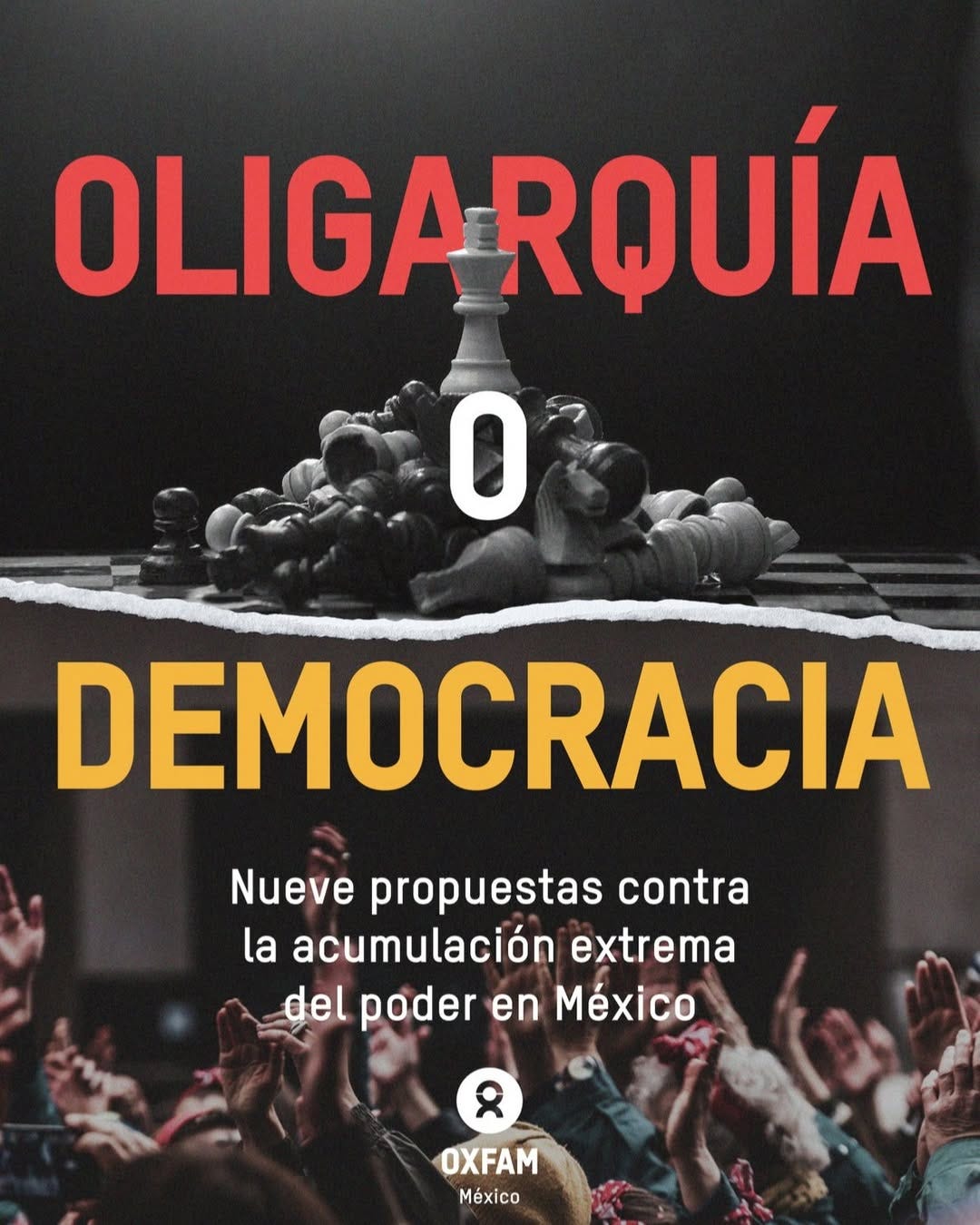
Last week, Oxfam Mexico launched another fantastic annual inequality report, Oligarchy or Democracy. Nine Proposals against the Extreme Accumulation of Power in Mexico (ESP). The paper lays out how Mexico has become one of the most unequal countries in the world, and presents how to transform the economy for the many with nine gender, climate, labour, and fiscal justice proposals.
Here are some of the main takeaways!
Inequality in Mexico…in numbers
Today, Mexico is one of the most unequal countries in the world. The richest 1% of the population (just 1.3 million people!) earn 35% of total income, hold 40% of the country’s private wealth, and are responsible for 23% of polluting emissions.
At the same time, 18.8 million people live without access to nutritious and quality food, 38.5 million live in social deprivation or below the poverty line, and 21 million women devote at least a full workday to unpaid care work.
Over the past 30 years, extreme wealth concentration in Mexico has consolidated. Mexico’s ultra-rich have never been as numerous or as rich as they are today. There are 22 billionaires with a combined fortune of 219 billion dollars, roughly equivalent to Qatar’s GDP.
Mexico confirms what Thomas Piketty argued in Capital in the Twenty-First Century: when the fortunes of the richest grow faster than the economy, economic inequality deepens. Between 1996 and 2025, Carlos Slim’s wealth increased more than eightfold, and billionaire wealth grew 4.2 times, while the Mexican economy did not even double in size. This model has been mediocre for the majority, but extraordinarily profitable for billionaires.
Recent experience shows that change is possible. Thanks to strong collective and democratic decisions by the government since 2017, the minimum wage has increased, which has made a big difference, although it is still far too low. Nevertheless, public investment as a share of GDP in 2024 was still less than half of what it was 45 years ago. Despite the growing concentration of wealth, the private sector invests less than $8 for every $100 dollars earned. Restoring public investment and democratically directing it toward the development of social and productive infrastructure are indispensable conditions for fair and redistributive growth. Economic democracy is not decreed: it is built.
The nine proposals included in the report seek to transform, repair, and redistribute so that the benefits of the Mexican economy cease to be controlled and concentrated by a few:
Mobilize investment flows in a fair and democratic manner.
Strengthen rights protection mechanisms.
Expand the mandates of economic policy regulatory bodies.
Showcase and address billionaire fiscal irresponsibility.
Promote inclusive care policies through collective participation.
Advance a new democratic governance of water as a human right.
Develop social infrastructure for the redistribution of care.
Reallocate the electricity subsidy so that it is progressive.
Finance electric mass public transportation in a progressive manner.
In the current international context, Oxfam Mexico says, these policies mean diversifying trade and investment, reducing US dependence, prioritising the domestic market, and building the state capacities necessary to seize new growth opportunities.
Taking measures in response to concentrated economic power in Mexico is not a threat to development: it is the only way to consolidate the social advances achieved in recent years and expand them for the benefit of the majority.
Thank you to the Oxfam Mexico team for their brilliant data-driven analysis and evidence-based policy solutions.
Something to read and listen to
Read the report by Oxfam Mexico (only in Spanish for now, but English translation coming soon!)
Listen to Alexandra Haas, Oxfam Mexico’s executive director.
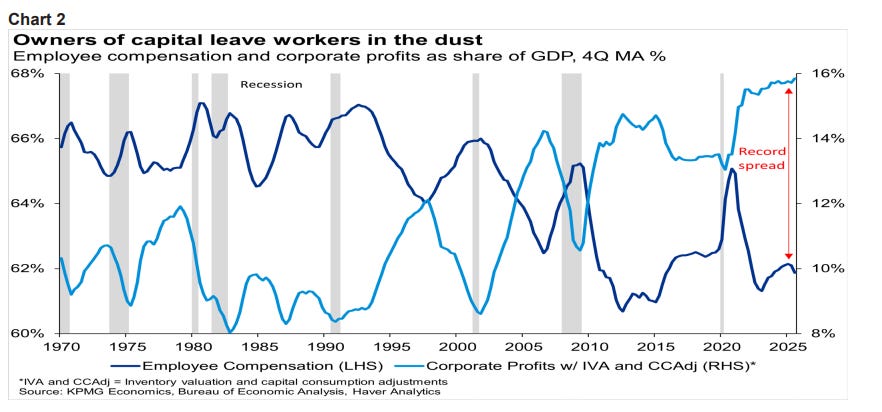
Chart of the week from KPMG showing how the share of the economy going to profits rather than wages has reached a post-WWII high.
Read this UNU Wider report about how global profit shifting contributes to cross-country inequalities.