


The insanity and inequality of prepping
In the UK and dozens of other countries all the talk recently is of “prepping,” where governments have issued guidance that we are supposed to hoard three days’ worth of food, water and cash in case of a sudden emergency.
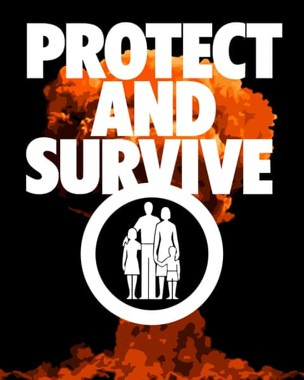
There was a similar fuss back in 1980 when the UK government issued a pamphlet called “Protect and Survive,” which explained steps families could take to mitigate the impacts of a nuclear attack. We were supposed to take doors off and prop them up against a wall, to create a form of shelter.
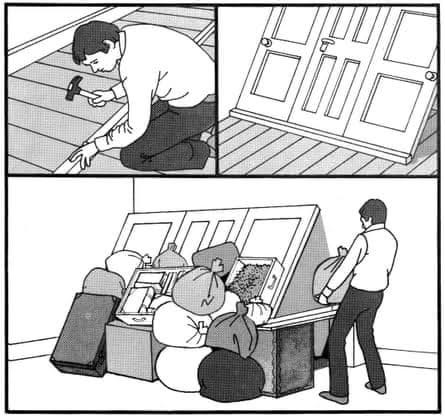
This basically made everyone scared, I remember being really petrified reading it as a young teenager. It was also ludicrous – not least because if Russia chose to fire a nuclear weapon at us, we would have between 15 and 30 minutes maximum to “prepare”.
Also then, as now, the guidance had in mind a suburban family; a family that would have the disposable income to buy more food and supplies than they need, and the space to store them too. Currently, 6 million people, including 14% of children in the UK, are food insecure and having to skip meals- they can’t afford to stockpile food.
As with all these things, the idea that preparing for a disaster should be the job of individuals or families is both unworkable and deeply unfair and unequal.
Equality as a cure for chaos and crisis
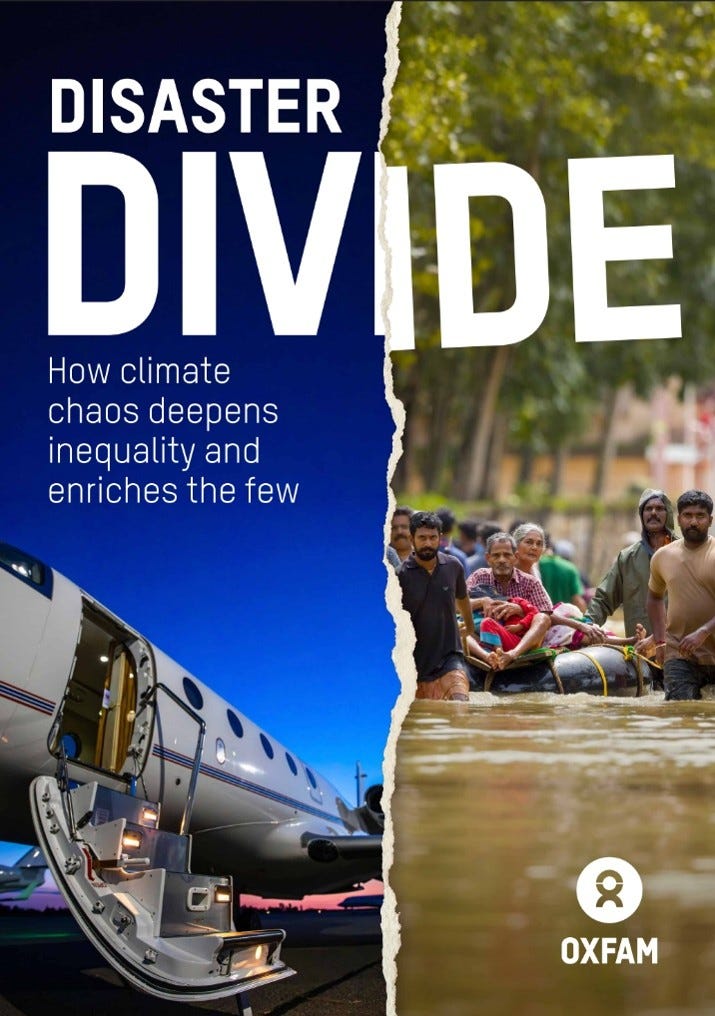
Oxfam’s climate and inequality paper published a couple of weeks ago, “Disaster Divide,” and our forthcoming annual inequality paper for Davos next year explores the relationship between disasters and inequality.
Greater levels of equality have long been concretely linked to a series of positive outcomes, whether it is healthier and longer lives, or a lower carbon, less consumption-driven society.
In these two reports, we are saying that greater levels of equality are also concretely linked to greater safety and security for all; that a lower level of economic inequality will reduce the number of crises, and their severity too.
On the face of it, it would seem strange to say that an extreme weather event like a typhoon, a pandemic, or a war would be mitigated by more equal societies. But when you think about it a little more, it does start to make sense. The argument is that there is no such thing as a “natural disaster” - there are extreme weather events, but what decides whether they become a disaster depends on the society they impact and how it responds. The same could be said for the outbreak of a disease. Wars and conflict have also been found to have a clear link to levels of economic inequality, particularly when this interacts with inequality between ethnic groups.
In our forthcoming annual inequality paper, we try to unpack why this might be the case, looking at three things that are more prevalent in more equal societies. First, the capacity for collective action and, underpinning this, two further things- the greater levels of trust and collective public wealth available in more equal societies.
Equality and collective action
When a crisis hits, what will enable a society to survive is not the actions of individuals and how many cans of beans they have bought. This is because the shocks we face as a species are problems that cannot be solved alone. They can only be solved, or at least dramatically mitigated and adapted to, by societies working together cooperatively and collectively. This is as true for a village that pools resources at times of drought, as it is for humanity facing the outbreak of a pandemic.
Collective action is in turn much more likely, and much more successful, in more equal societies. A large body of empirical experimental work on people’s behaviour has shown that when large differences in power or resources are introduced within a group, this in turn makes cooperation and collective action harder
Trust and public wealth are higher in more equal societies
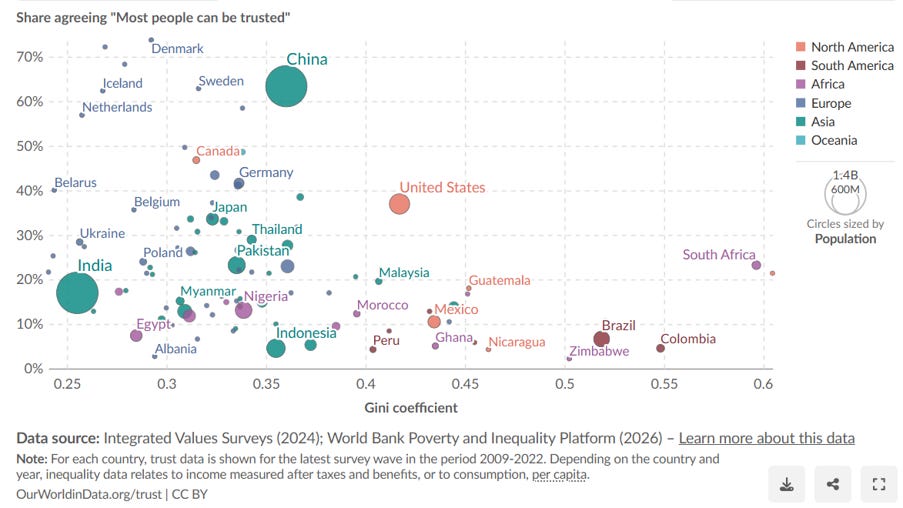
Collective action also requires high levels of trust, and of collectively owned resources that can be used when a crisis hits. Both are also much more likely to exist in more economically equal societies. In situations of crisis or shocks, trust is absolutely vital. People might have to follow official advice, volunteer, work with and coordinate with neighbours, share information, and accept restrictions and instructions without having the time or ability to verify information themselves- all this requires high levels of trust. Data both between and within countries shows us that greater equality is associated with higher levels of trust.
The other key thing that equal societies tend to do is to not just distribute income and wealth more fairly between private individuals, they also tend to pool some of that income and wealth, and to invest this public wealth in ways that will benefit the majority and help support those who need it. In situations of crisis and shocks, the ability of governments to mobilise resources fast and direct them to the right places is vital and is linked to the scale of the public sector and pooled public resources available.
During the COVID-19 pandemic, huge actions had to be taken by governments, in the areas of health and in the support of people’s livelihoods. And for these actions to be successful, high levels of trust in governments were required. When that trust broke down, or where governments either were unable or unwilling to mobilise public resources, the impact of the disease was far worse.
Less money for bad men
The final, and perhaps strongest link between reducing chaos and crisis and greater equality is arguably the reduction that it would bring in the power and influence of the super-rich. It seems clear that the richest people in today’s world have very often converted that wealth into huge influence over politics, society, the media and social media, and that they also often use that wealth and influence in ways that make crises more likely and more acute; whether it is energy billionaires profiteering from energy price shocks or tech or crypto billionaires funding far-right political parties and the media. Our inequality paper next year will demonstrate this, with some amazing new analysis showing that a significant section of the super-rich have a vested interest in chaos and not calm.
A more economically equal society would simply not give anyone that amount of wealth in the first place. Chaos-loving individuals with far-right views will probably always be with us, but at least they would not be backed up by a war chest of hundreds of billions of dollars.
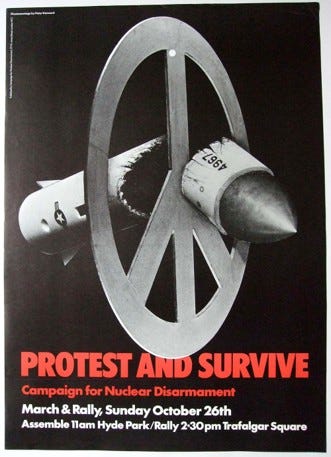
Protest and Survive
My parents were very active in the Campaign for Nuclear Disarmament (CND) who put out an alternative slogan, entitled instead: “Protest and Survive.” I think they were right. It seems clear to me that a more equal society would be almost certainly a much safer and secure one, with fewer crises and shocks. It is also clear that we won’t get that society without fighting for it.
Author: Max Lawson, Head of Inequality Policy at Oxfam International and EQUALS podcast co-host. He is also a visiting Professor in Practice at the LSE International Inequalities Institute and the co-chair of the Global People’s Medicines Alliance.
Read our latest bulletin: Billionaires flock to COP31 in their private jets.
Billionaires flock to COP31 in their private jets

“Like inviting an arsonist to a fire-fighting convention” is how the huge numbers of fossil fuel lobbyists at COP are often described.