


There was the COVID-19 pandemic, then the invasion of Ukraine, then the trade war, and then the war against Iran. You might think that donors would seek to alleviate the dramatic impacts these global events have on poverty and inequality worldwide. You would be wrong. World leaders compound the “polycrisis” by turning their back on global solidarity. Adding insult to injury, they divert what’s left in aid budgets to pursue their own national or private sector interests.
For the past twenty years, (too) slow progress has been made to increase aid effectiveness, based on key principles like recipient country leadership and a focus on ending poverty and reducing inequality. Over the past year, however, a long-simmering alternative paradigm has come to prominence. Known as “trade over aid” in the US, “from donor to investor” in the UK, or “Global Gateway” in the EU, it consists in two pillars: aid must now serve the “mutual interests” of both the donor and recipient country, and a primary goal of aid should be to leverage private finance. In other words, full rudder back to the bad old days of twentieth century neo-colonialism.
Aid in numbers
Aid budgets plummet. Aid has fallen by 28% between 2023 and 2025. The United States is the biggest scrooge, but many other countries including France, Germany and the United Kingdom are to blame as well. They have announced further cuts through 2030.
Aid is peanuts. Aid budgets were never high to begin with. At its peak in 2023, aid represented only 0.37% of donors’ Gross National Income. Even that is inflated, as official aid statistics include things that don’t belong: host countries’ refugee costs (13% of total aid budgets), overseas students’ stipends, double-counted debt relief, and some subsidies to donors’ outward foreign investment.
Aid cuts kill. Based on aid’s past track record in fighting HIV-AIDS, malaria, malnutrition and other diseases, the Institute of Global Health in Barcelona estimates that projected aid cuts will kill about 9 million people by 2030.
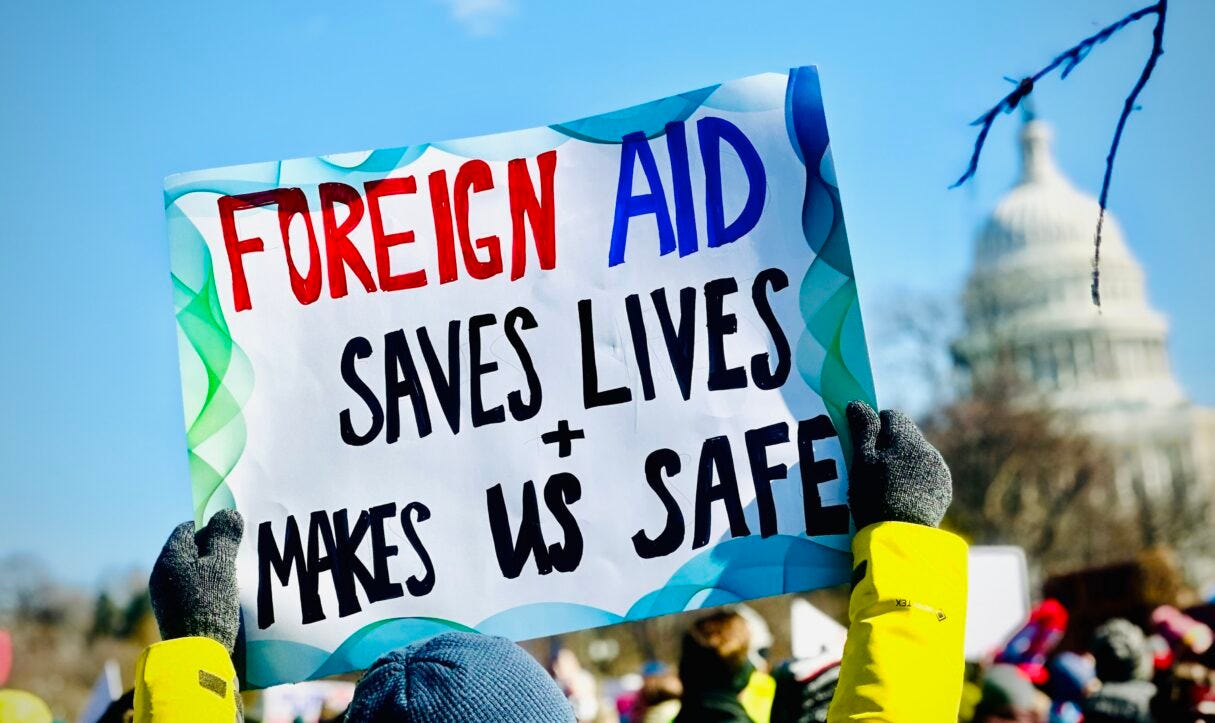
Aid works. In addition to saving lives, aid has multiple other benefits. Over 35 million primary school children depend on it for their education, 14 million of whom are at risk of dropping out. Investing in conflict prevention costs 100 less than in crisis response. Aid boosts economic growth, such that 32 countries “graduated” from or outgrew World Bank aid.
People care. Public opinion in donor countries remains supportive of aid. While aid is not at the top of the public’s priorities at times of belt-tightening, that is in part due to people not realizing how small aid budgets actually are. And while there are lingering perceptions of waste – fed by overt lies – the right response to that is to double-down on the aid effectiveness agenda, not to turn its back on it.
Instrumentalized aid does not work. Aid is indirectly in the interest of donor countries, as they benefit from a more stable and prosperous world. However, experience has shown that when donors directly use aid budgets to push their own agendas onto partner countries, aid becomes less effective. If donor governments want to increase their own competitiveness or security, they should do so with separate budget lines.
There is another way: tax the rich. Over the past 12 months alone, billionaires have gained $4 trillion, bringing their wealth to $1.5 trillion more than that of the poorest half of humanity. Taxing the rich could raise $2.5 trillion annually, more than enough to end poverty in the world.
Thankfully not all donors are cutting or instrumentalizing aid. Denmark, Norway and Spain are among the few countries bucking the trend, although the latter has a way to go to reach the 0.7% of GNI budget target. We must remind all donor governments that this time of global crisis calls for more global solidarity, not less.
Something to read/listen to
Read Oxfam’s “Beyond the Targets” report that lays out an agenda to put aid back on track.
Listen to the latest episodes of the Equals podcast


Watch this new viral video from Patriotic Millionaires that explains extreme wealth inequality.
Read this journal article that shows that wealth inequality has a large negative effect on economic growth.
Read Zucman’s case for California’s billionaire tax in The New York Times.
Watch friend and colleague Kwesi Obeng being interviewed on “Are billionaires good for Africa?” based on Oxfam’s brilliant Africa inequality report from last year.
Watch Eurodad’s new series of stories and a film on the “true cost of debt,” stories coming out between May and October.