


International Workers’ Day is a time to celebrate victories for worker organisations. From achieving fairer pay and working conditions to fighting for gender and racial equality, trade unions have achieved huge successes for workers’ rights. However, massive inequalities between billionaire and CEO fat cats and workers show how far there is still to go.
New analysis by the ITUC and Oxfam reveals extensive erosion of average global wages since the pandemic, while the chief executives of the top paying companies have received massive pay hikes. Billionaires are richer than ever before, and the research provides new insight into the huge dividends they are being paid.
This week’s bulletin looks at the growing divide between workers and fat cat CEOs. Next week will focus on the billionaire bonanza.
Working for the rich… in numbers
The context. Even before the most recent energy crisis caused by the unlawful attacks by Israel and the US, and Iran’s response, people were reeling from a series of price shocks that they have never recovered from. Between 2019 to 2025, food prices increased by 15% and gasoline prices by 14% in real terms. In 43% of countries, governments have not increased minimum wages in line with inflation during this period.
Progress against in-work poverty has decelerated sharply. Between 2000 to 2019, working poverty was falling at 7% per year on average - since 2020 the rate of decrease has more than halved to 3%. Having a job is no guarantee of escaping poverty.
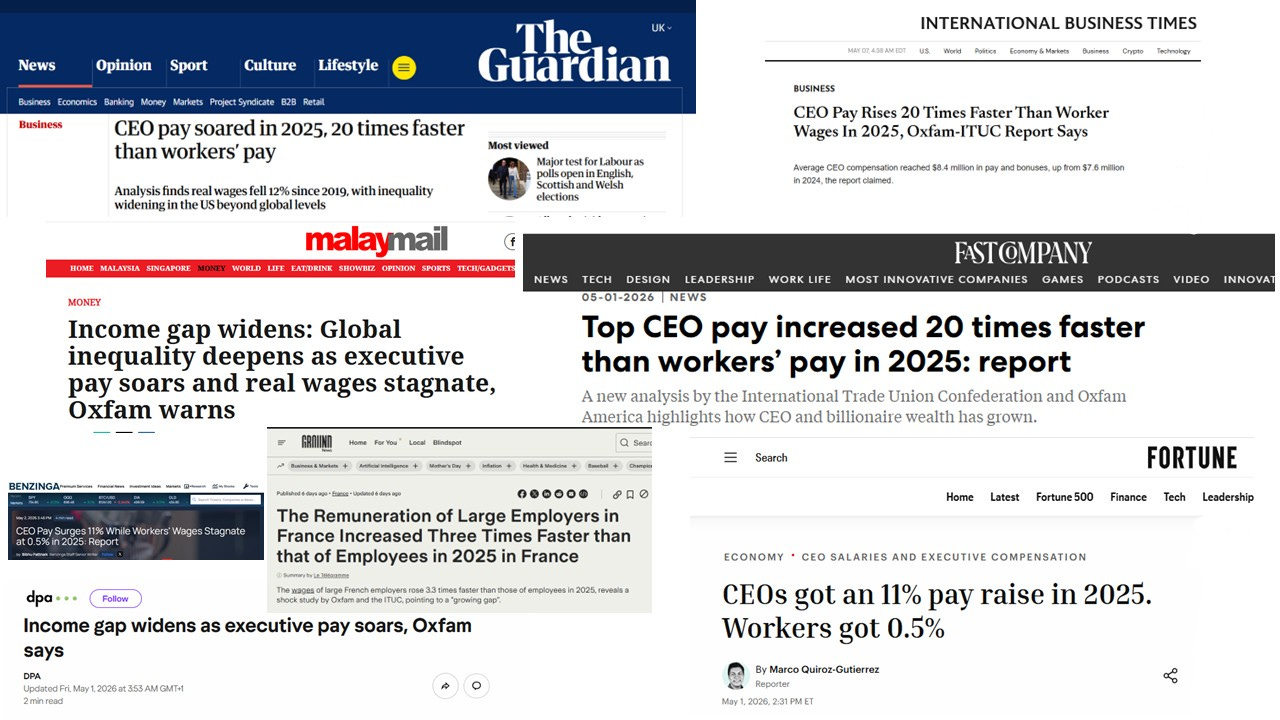
A boom year for CEOs. In 2025, the world’s top 1,500 best paid CEOs got an 11% real term pay rise compared to the year before. Compared to workers, whose pay increased by just 0.5%, their remuneration increased 20 times more than the global worker average. It would take 490 years for the average worker to make what the average CEO made in 2025 alone.
The fattest cats of them all. The 10 highest paid CEOs were collectively paid over $1 billion in 2025, four of them paid over $100 million. Top paid executives include the CEO of semiconductor corporation Broadcom who was paid $205 million, the CEOs of investors and bankers Blackstone and Goldman Sachs who were paid $126 million and $119 million respectively, and Microsoft CEO paid $96 million.
Pay cut for workers. Global average pay has fallen by 12% since 2019 while CEOs have had a 54% pay rise over the same period. In 2025, workers effectively worked 31 days for free. Since 2019, workers have effectively worked a total of 108 days for free.
Persistent gender pay gap. Within the top paying 1,500 companies just 6% of the CEOs are women. The average gender pay gap of employees in these 1,500 companies is 16% - this means that women will effectively stop being paid on 4 November this year.
Decline in labour share. The labour share of GDP is a measure of how much economic value goes to workers compared to the people who own capital, for example shareholders and landlords. Since 2019, the labour share has declined by 0.4 percentage points, costing workers $469 billion in 2025 and exacerbating the gap between capital and labour.
Despite increasing productivity. The economic output per worker has increased by 51% compared to 2004 but workers are receiving 2% less share of income. Reasons for this include wage suppression and the decline and repression of trade union membership, the acceleration in technology and automation, the financialization of the economy, and market concentration of large corporations. The consequences have been higher profits for shareholders with a lower share going to wages.
Make sure to subscribe for part two next week on how the billionaire bonanza is funding anti-democratic, anti-worker projects.
Something to read/listen to
Listen to the latest episode of the Equals podcast with Adam Hanieh who explains why crises like war, financial shocks, and pandemics don’t stay where they start. They move through the structures of the global economy.

A new database focusing especially on the transfer of wealth through inheritance. It also includes information on how inheritance is taxed in different countries and time periods.