


This year, the U.S. holds the presidency of the G20, a multilateral forum featuring many of the world’s largest economies, including China. Yet the U.S. has largely not used the G20 to advance discussions on restructuring critical minerals markets. Instead, a few weeks before attacking Iran, the Trump administration convened a separate Critical Minerals Ministerial to secure deals for a critical minerals supply chain resilient to “external actors.” Or, in the words of Vice President JD Vance, to ensure this essential supply would not disappear “in the blink of an eye, without the control or influence of any country in this room.” The implicit reference was to China, which dominates the extraction and processing of critical minerals.
Simultaneously, more than 5,000 kilometers south of the U.S. capital in the Brazilian city of Santarém, located in the Amazon, hundreds of members of more than 15 Indigenous peoples were mobilizing together in protests and occupations. They were confronting two measures by the Lula government: a federal decree that opened the way for the privatization of Amazonian waterways, and the authorization for the dredging of the Tapajós River — one of the main rivers in the Amazon.
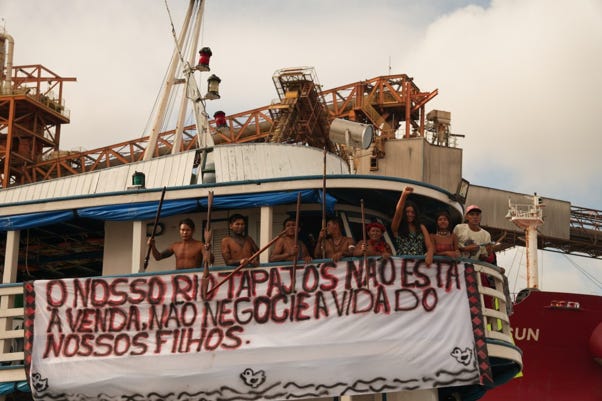
The dredging aimed to increase transport capacity for products like grains and minerals, favoring export corporations at the expense of the Indigenous river and riverside communities. The struggle lasted more than thirty days and led Indigenous peoples to occupy the facilities of a large U.S. company operating in the country, which is facing civil lawsuits in Brazil following reports of labor conditions analogous to slavery within its supply chain. The Indigenous mobilization succeeded and led the federal government to revoke both measures.
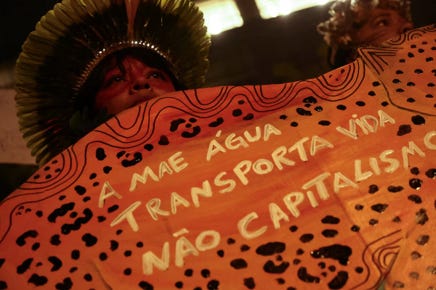
The protests in Santarém anticipate conflicts that are likely to deepen. Despite the physical distance, Washington and Santarém reveal two sides of the same coin: while powerful countries dispute control over critical minerals, Latin American territories are pressured to adapt to the needs of extraction and transport.
Latin America is at the forefront of the race among countries and corporations to secure natural resources. The region is responsible for 35% of global lithium production, concentrating more than half of the reserves of this mineral in countries such as Argentina, Chile, and Bolivia. Brazil alone has the largest known reserves of rare earths outside of China.
The infrastructure works contested by Indigenous people in Santarém are part of a broader Brazilian federal agenda of construction, privatization, and improvement of export routes still underway. The data are alarming: there are requests to explore critical minerals in areas surrounding more than 270 Indigenous lands, or 44% of these territories nationwide, and may affect 31 Quilombola[1] territories, equivalent to 24% of the Quilombola area in the Legal Amazon[2].


A recent report published by the Articulation of Indigenous Peoples of Brazil (APIB, in Portuguese) is revealing. It details the pressure created by mining companies’ lobbying in the country and shows how mining interests have penetrated across all three branches of government, under the guise of energy transition, sovereignty, and sustainable development[3].
Latin America’s immense resource wealth has made it a priority for U.S. foreign policy. Trump has resorted to direct military interventions, supporting right-wing governments, and pressuring countries directly, as in the case of the Panama Canal, where Panama’s Supreme Court reversed a concession previously granted to a Chinese company following Trump’s repeated claims that China was controlling the canal. Another recent episode was the purchase of the largest known rare earth reserve in Brazil, Serra Verde, by a U.S. company backed by the Trump administration. The region is also subject to Chinese influence. China is the main export destination of several countries in the region[4] and has financed and operated key infrastructure projects, such as the Chancay megaport in Peru, which has faced allegations of regulatory and environmental irregularities.
New South American infrastructure projects bring back old questions about dependency, development, and regional integration.
For example, the South American Integration Routes, designed by the Brazilian government with other governments in the region, foresee five routes connecting the continent’s interior to Pacific ports. Although presented as integration and development, these works may reaffirm the region’s agrarian and extractive dependency by privileging the transport of grains, minerals, and other raw materials. They also raise questions about the viability of some routes and their impacts on Indigenous territories, not only in Brazil, but also in neighboring countries such as Paraguay. Once again, development appears as a promise. But development for whom? Under what parameters?
In this context, it is worth turning to an observation from a recent Oxfam panel, Beyond America First: U.S. International Economic Policy in a Multipolar World: the contradiction that Global South governments risk, under a discourse of anti-imperialism or nationalism, ending up defending policies that benefit local oligarchies and deepen national inequality. This warning helps us think beyond rhetoric, and instead ask what is the actual content of the policy and which sectors are affected by it.
In Latin America, these questions become urgent, especially given that imperialism also relies on local elites and other non-government actors. The advance of mining, infrastructure, and export corridors threatens to deepen violence against Indigenous peoples, riverside communities, Quilombola lands, workers, and poor populations. It also poses an environmental threat, given the Amazon’s essential role in regulating the global climate system. This is not a distant risk, but a process already underway. It is not enough to denounce foreign intervention, while projects presented as development extract wealth from these territories.
The mobilization in Santarém shows the strength of Indigenous resistance, but also the scale of the struggle ahead. Indigenous peoples have succeeded, yet remain largely alone in a complex scenario shaped by U.S. and Chinese interests, local elites, and a Brazilian government that presents this model as development. Supporting these struggles is therefore not secondary. Building common forms of defense with the people on the front line of this offensive is an indispensable part of any consistent anti-imperialism.
END.
[1] Territories of Black communities whose history is rooted in resistance to slavery and whose struggle today centers on collective land rights, memory, and ways of life.
[2] The Legal Amazon is a political-administrative concept used by the Brazilian government for public policy purposes and as a reference for deforestation measures. It encompasses an area larger than the Amazon biome itself and corresponds to about 59% of Brazilian territory.
[3] In the Legislative branch, the report traces this offensive through bills that seek to weaken environmental licensing and Indigenous territorial rights; in the Judiciary, through disputes in the Supreme Court over the interpretation of Indigenous rights and “national interest”; and, in the Executive, through federal plans, programs and regulatory bodies that frame mining as public interest and national development.
[4] According to UN Trade and Development (UNCTAD) data, in 2024 China was the main destination for exports from Brazil, Bolivia, Chile and Peru.
Author: Daphnae Picoli is a political economist. She holds a MA in Economic Development from the Unicamp (Brazil) and is currently a PhD candidate in Economics at the same institution.
The views expressed in this post are those of the author and do not necessarily reflect the official policy or position of Oxfam.
This is the first entry in our new G20 In Flux blog series, unpacking the key issues shaping the US-led G20. Subscribe now and follow the series as we explore what’s at stake for the global economy and beyond.
