


Something is changing. At Oxfam, we started banging on about the need to tax the super-rich many years ago. Sometimes it felt a bit lonely.
Now wealth tax economists are becoming household names, and people are marching in the street calling for taxes named after them!
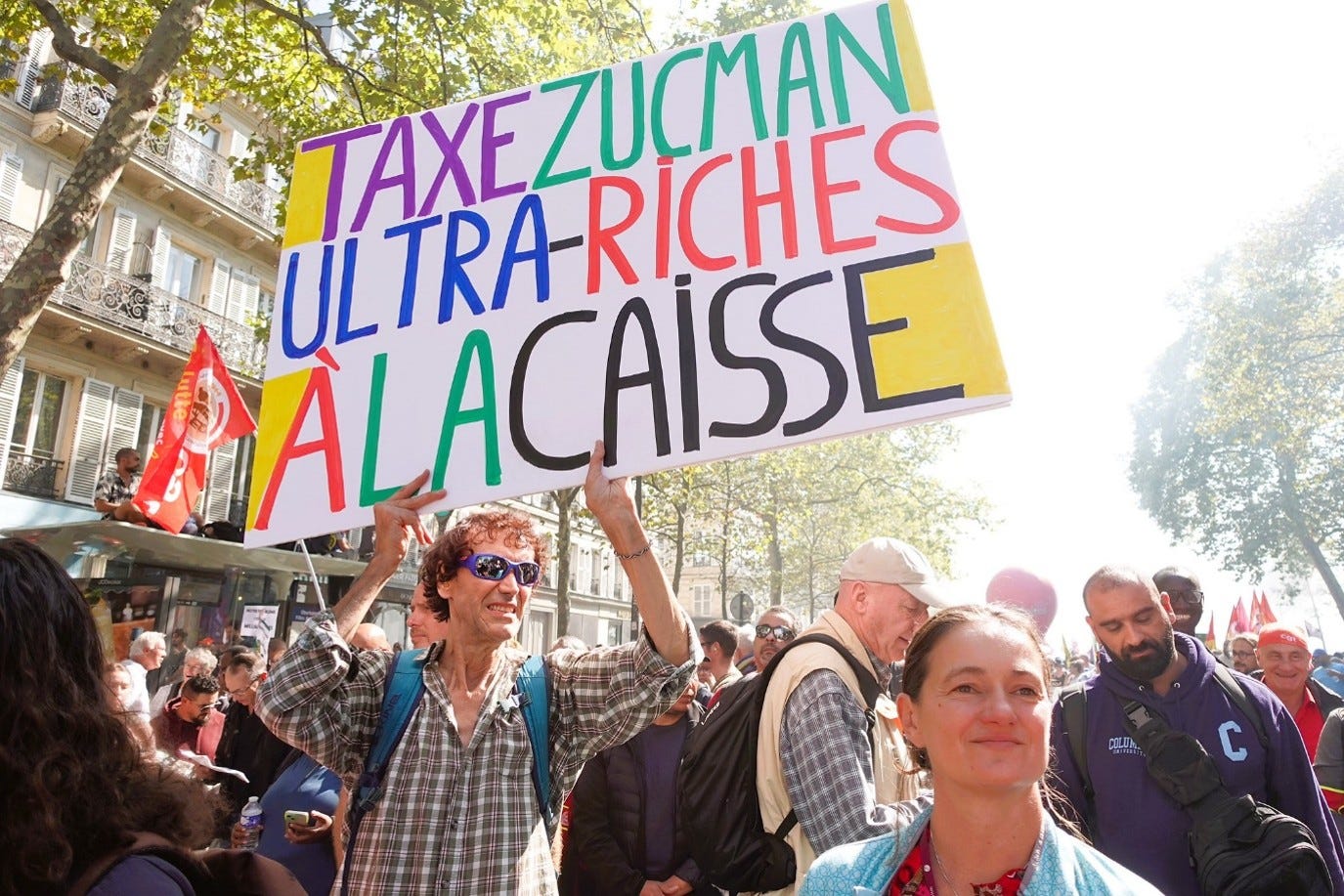
Sure, among ordinary people there was widespread support. But the tide is turning among governments, mainstream economists and the media.
The idea that the rich should be taxed more was routinely dismissed as either extreme or unworkable - or both. Not so anymore.
In this week’s Bulletin, we’re going back to our roots and giving people some scope for hope. We’re winning the fight to tax the super-rich.
Progress towards a wealth tax on the super-rich
Already being introduced. Just in the last few years, wealth taxes on the super-rich have been introduced or strengthened in Colombia, Norway, Spain, Tunisia, Argentina and Bolivia.
New proposals are popping up everywhere. In California, a state in the Western United States, voters will decide in November if the super-rich should pay a one-off 5% wealth tax. In Denmark, the Prime Minister of the party that abolished the country’s wealth tax 30 years ago just ran an election campaign on the promise to reintroduce the tax.
Multilateral shifts. The G20 under Brazil called for international coordination to tax billionaires. A binding tax convention currently being negotiated at the UN recognizes that countries need to work together to make sure that the super-rich are taxed more effectively.
Come a long way. It is difficult to understand just how seismic these shifts are without comparing them to what came before. In past decades, a relentless war on fair taxation led country after country to repeatedly cut taxes on the rich.
Wealth taxes were decimated. For example, in 1990 there were 12 OECD countries that had a wealth tax on the richest. In just three decades, that number collapsed to three. Meanwhile billionaire wealth has skyrocketed from 2.5% of global GDP in 1990 to 14.1% today.
Taxes on the income of the rich slashed. From 1980 to 2022 the top tax rate on the income of the richest fell from 59.5% to 40.4% – a drop of nearly a third. In the same period, the income of the richest 1% increased by 45%.
Offset by taxing everyone else. While taxes on the rich were being dismantled, taxes on everyone else were being raised. Today, whenever 1 dollar is raised in taxes, only 8 cents are raised from taxes on the wealth of the rich, while nearly 33 cents are raised from inequality-enhancing consumption taxes.
Trickle up economics. Tax cuts for the rich were made with promises that the gains would eventually trickle down through jobs, investments and growth, but research shows what most people already suspect: the only beneficiaries were the rich, while growing inequality harmed our democracy, climate and progress against poverty and hunger.
We’re now (cautiously) winning. As we continue to fight against those waging the war on fair taxation, we are hopeful that we are finally winning. In the age of the first trillionaire, it’s not a minute too soon.
What is giving you hope? Comment below.
Something to read/listen to
Read Who wants to tax a billionaire? A light-hearted guide to the tax the rich characters. We love the idea of rebranding killer stats as statistical rage bait!
Read about how South Korea plans to tackle inequality by establishing a future fund using extra tax revenue generated by the semiconductor boom.
Watch Jayati Ghosh on why we must move beyond growth.
Watch How to get filthy rich with Gary Stevenson (only available in the UK).
Watch Patriotic Millionaire’s new wealth tax campaign video.
Read Growth, Democracy, or Climate Action? The new trilemma of advanced capitalism. We love the conclusion of degrowth for the rich, green growth for the rest.