



Money earned from work versus money earned from wealth
In economics, two are two primary sources of income: money earned from work, known as labour income, and returns on savings, known as capital income. Together, labour and capital make up the total income of a nation.
Throughout the 20th century, the traditional understanding in economics was that this would be broadly split, with 75% of income going to labour, and 25% to capital. This 75:25 split was taken to be what economists call a ‘stylised fact’ (which always makes me think of a very well-dressed fact). This is their way of talking about a kind of a priori law or rule; one that they maintain holds true across all economies. This one was called ‘Bowley’s law’ and was a staple of economics textbooks.
Earning money from savings and capital is in some ways everyone’s dream – literally, too, as it was immortalised by billionaire Warren Buffet’s famous warning: ‘If you don’t find a way to make money while you sleep, you will work until you die.
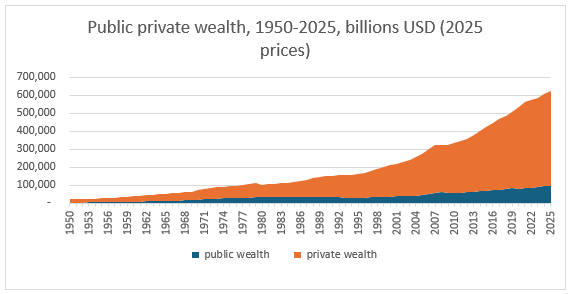
In recent years, there has been an absolute explosion in private wealth and capital - it is one of the defining economic developments of the last twenty years. Understanding who is actually making money from that capital has never been more important. So today, who is making money while they sleep?
Who actually receives income from wealth?
To answer that, a recent paper by Branko Milanovic and Marco Ranaldi, published by the London School of Economics (LSE), is absolutely vital reading. It draws on the incredible database of the Luxembourg Income Study (LIS), covering 43 countries and 4.6 billion people, spanning countries where virtually all global wealth is concentrated. They then use this as the basis to calculate global figures.
Milanovic and Ranaldi calculate two things: what proportion of the global population receives $100 or more a year in cash income from capital, and how that income from capital is divided up between them.
Their findings are dramatic. For most countries, especially in the Global South, the proportion of the population receiving zero income from capital is very high. For example, in Mexico it is 97%, and in South Africa 95%. In rich countries it is lower, but there is a lot of variation, too. In the UK it is 74% and in France it is 48%. This variation is due mostly to how widely spread and generous pension schemes are, because for the vast majority of people who do receive income from capital, it comes from their pension.
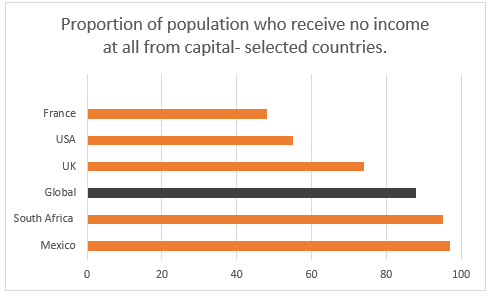
Overall, globally, the authors conclude that 88% of people receive zero income from capital.
How is income from wealth distributed between those who do get some?
They then look at how income is distributed among the 12% of humanity that does get more than $100 dollars a year in income from capital. The ‘good’ news they describe is that this has become progressively more equal, largely due to the impact of wealth growth in China. They calculate that the Gini coefficient of income from capital has fallen from 0.97 in 2000 to 0.94 in 2020.
Now, when you work on inequality, you see a lot of Gini coefficients - with 0 as perfect equality, and 1 as perfect inequality. The most unequal countries in the world have Gini coefficients of around 0.6. You very rarely see Gini coefficients of 0.9 or above- that is pretty close to total inequality. This gives you some idea of just how unequally divided incomes from capital are, and whilst a fall from 0.97 to 0.94 over 20 years is indeed a good thing, it still leaves an insane level of inequality. In contrast, the ILO calculates the Gini coefficient for income from work as around 0.57 - still high, and much higher that it was or should be - but far lower.
This means that even in those countries like France or the US where the proportion of people getting something in terms of income from capital is higher than in other countries, the distribution of that income is still extremely unequal- much more unequal than incomes from work.
Capital’s slice of the economic pie grows ever bigger
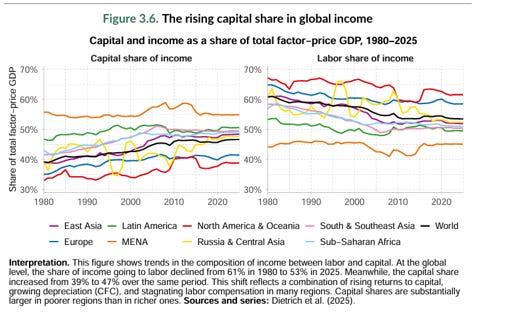
This also matters increasingly because income from capital has become a larger and larger slice of total national income. The latest estimates from the ILO show that the capital share has risen to 47.4%, or nearly half of total national income. This is up from around 39% in 1980. So much for that stylised fact in the economics textbooks.
AI may supercharge this process, favouring capital over labour
It is also likely that unless things change, this trend will both continue and be potentially accelerated by AI and automation. Buried in the recent Annual Economic Report by the Bank of International Settlements was this rather scary graph:
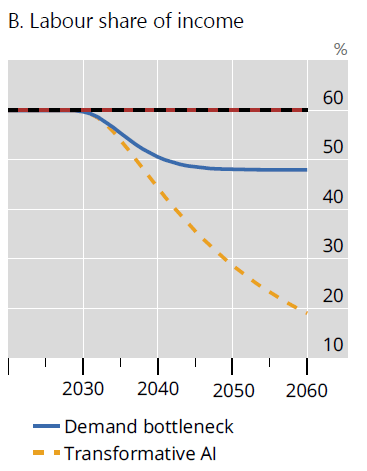
It projects under one scenario that AI could reduce the labour share of income to 20% - which without a total transformation in ownership and the economy would be catastrophic for almost everyone on earth, given that we know 88% of people only get income from work.
In the other scenario, what the Bank euphemistically calls the ‘demand bottleneck’, the labour share falls to 40%. What this means is that people are so impoverished by unemployment and poor pay due to automation that they can no longer buy the products that AI is producing, so ‘demand’ would decline sharply, which in turn they believe would inhibit the further ‘supply’ of AI.
Beating organised money with organised people.
So, what can be done to stop this? The good news is we are not short of policy solutions - I can think of three big ones.
The first is to ensure that the labour share of income does not continue to fall but rises - and here the power of trade unions and organised labour is critical. Much more money needs to go into paying people living wages rather than into profits, and the way to do this is for unions and workers to become more powerful.
The second is we need to stop jobs being automated away - just because a robot can drive your delivery van or care for your elderly mother does not mean it should. This requires democratic and not oligarchic control and ownership of new technology to ensure its deployment for the benefit of all.
The third is to dramatically increase the taxation of wealth and income from capital, and ensure that revenue is distributed fairly and widely, either through direct cash payments or through universal public services like health, education, transportation and energy.
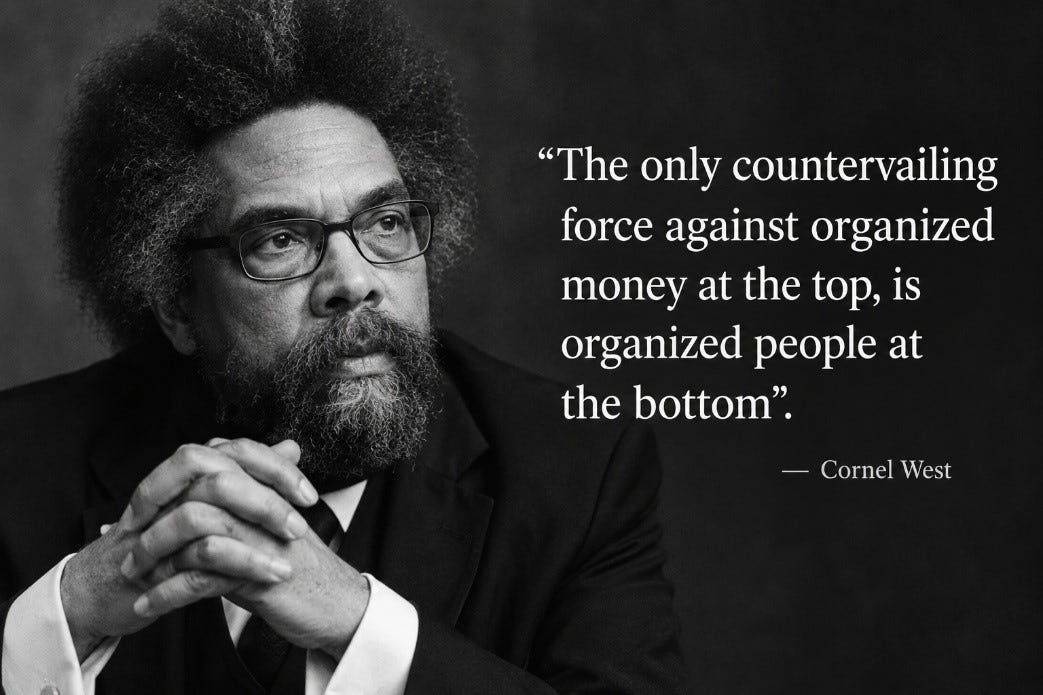
None of this is easy, though, because the owners of capital are very powerful, and very influential. The central thing that has beaten them historically, short of revolution, is workers power translated into organised people’s movements and progressive parties that were able to rebalance the scales in favour of ordinary people. Or as the philosopher Cornell West more pithily put it: ‘The only countervailing force against organized money at the top, is organized people at the bottom.’
(this blog was inspired by the first interview of our new EQUALS podcast season, with Branko Milanovic- who is one of the most interesting thinkers in the world. Do have a listen it was an a great conversation, ranging from the Soviet Union to AI to his ideas on how neoliberalism is dead globally but alive and well nationally.)

END
Author: Max Lawson, Head of Inequality Policy at Oxfam International and EQUALS podcast co-host. He is also a visiting Professor in Practice at the LSE International Inequalities Institute and the co-chair of the Global People’s Medicines Alliance.