


The war in the Middle East has brought devastation to the people living in the region, with the human cost spreading across the world. Food and energy prices are soaring, and as we know from the polycrises that defined this decade, there will be a deadly consequences in global levels of hunger, poverty and inequality.
We also know that wherever there is huge market volatility and turmoil, there’s also an opportunity for shareholders to profit.
Following Covid and the invasion of Ukraine, the very richest became dramatically richer and corporate profits hit record highs. Between 2020-2022, food and energy billionaires pocketed $453 billion, with 62 new food billionaires minted. Five of the largest energy companies – BP, Shell, TotalEnergies, Exxon and Chevron – were making a combined profit of $2,600 every second, as energy prices rocketed following Russia’s invasion.
This is highly likely to repeat itself, and we’ll be analysing the impact of the war on inequality in future Bulletins. As the data in this week’s Bulletin, analysing the Forbes 40th annual billionaires list, shows, the super-rich are starting from an even higher point than ever before.
Make sure to subscribe, as we’ll be looking specifically at war profiteers in future editions.
The billionaire list…in numbers
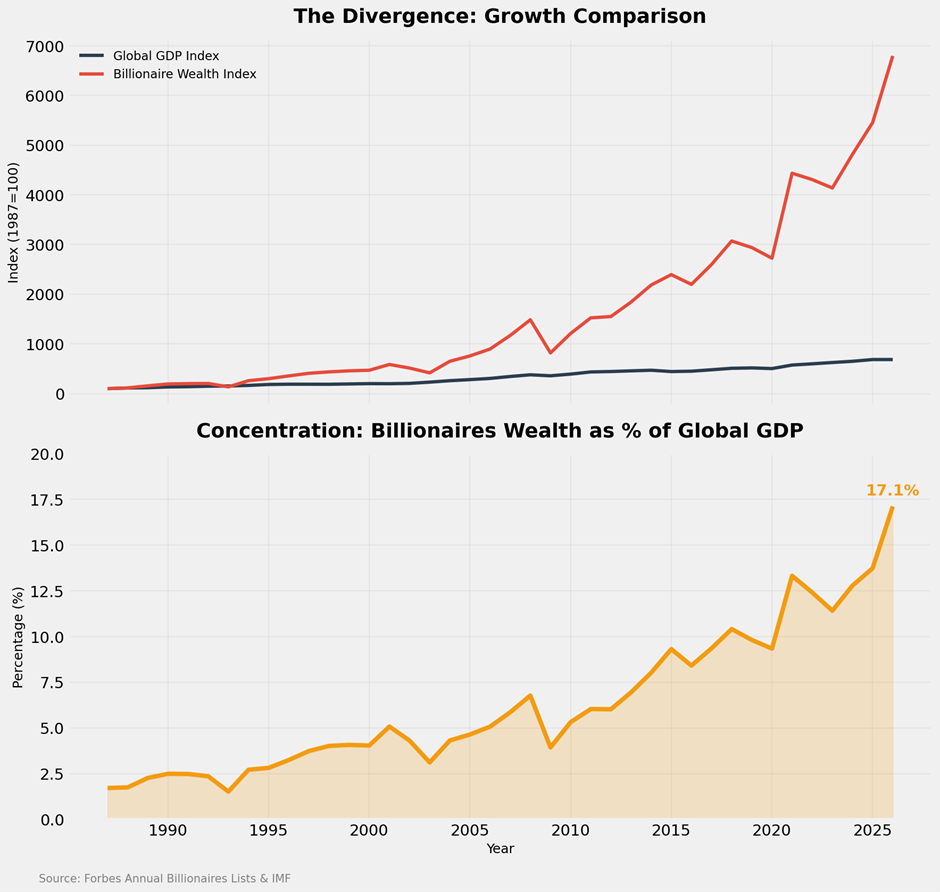
Another record-shattering year for the world’s richest people. Both the number and the wealth of the world’s billionaires are at their highest levels. There are now a record 3,428 billionaires worldwide. Their combined wealth is a record $20.5 trillion, equivalent to the size of mainland China’s economy. Their wealth is equivalent to 17.1% of the global GDP, compared to less than 5% in 2010.
The world’s billionaires are $4 trillion richer than 12 months ago. This is $1.5 trillion more than the combined wealth held by the poorest 4.1 billion people in the world. An increase of about a quarter. Their number increased by 400, a 13% jump. At the top, the 10 richest billionaires are 44% richer. All in all, 4 in 5 billionaires are richer than they were last year.
A trillionaire is in sight. The world’s richest person is only $160 billion shy of becoming the first trillionaire, years earlier than projected. Elon Musk has a net wealth of $839 billion, having added around half a trillion in just a year. In fact, he’s $121 billion richer than the next three richest billionaires combined, and richer than the poorest 693 billionaires.
AI boom for billionaires. 390 people entered the billionaire club with a combined net worth of $755 billion. Artificial Intelligence (AI) played a huge role in this. 45 new AI billionaires have been created over the past 12 months, accounting for more than half of the total of 86 AI billionaires.
Technology accounts for nearly a quarter of the total wealth, which has boomed over the past 12 months. The combined wealth of billionaires in the technology industry is up nearly 50%, a $1.6 trillion jump.
The US has the most billionaires and the wealthiest. This year, billionaires span 80 countries, including, for the first time, Afghanistan. Yet most billionaires are concentrated in a few countries. The United States accounts for the most billionaires in the world, with 989, or 30% of the total, and the most wealth, $8.4 trillion, or 42% of all billionaire wealth. US billionaires are 23.4% richer than a year ago, having added $1.6 trillion to their stock of wealth.
Some countries recorded a massive increase in billionaires’ wealth. Irish billionaires are 254% richer, those in the Netherlands 243%, Canada’s 111%, Brazil’s 81%, and those in Sweden 47%.
Billionaire gender divide. It’s well known that, globally and in many countries, women own less than men. And that’s true at the very top. Women account for 14% of the total billionaire class.
More wealth at the top, increasing suffering for many. As billionaires’ wealth hit $20 trillion, much of the world’s population faces immense suffering. Some 2.3 billion people in the world are regularly facing hunger, 2.8 billion people have no adequate housing, and 2 billion are facing catastrophic out-of-pocket health spending.
Not just the wealth that should worry us. It’s not just trillions of wealth in the hands of a few, but also its impact on democratic institutions. Increasingly, we are seeing billionaires concentrate media ownership to serve their selfish interests. They are hijacking our public institutions and democracy, as we showed in this year’s Davos paper.
Something to read and listen to
Listen to K. R. Ghodsee on Equals talking about Capitalism vs Socialism: What’s Better for Women’s Rights?
Listen to Zoe Gardner and Sharon Ekambaram on how How Migrants Are Used as Scapegoats for the Real Crisis
Read Ken Opalo’s analysis of the short and medium term impacts of the U.S./Israel-Iran war.
Read what the IMF have to say about how extreme inequality is fueling a global debt crisis.