


The events of 2025 made one thing painfully clear: the world’s super-rich have not only accumulated more wealth than could ever be spent – they have used this wealth to secure the political power to shape the rules that define our economies and govern nations and the world.
In this week’s Bulletin, we’re diving into Oxfam’s latest inequality report on the political influence of the super-rich.
If you haven’t already, then check out part 1 on how billionaire wealth has reached a historic high.
Economic inequality becomes political inequality…in numbers
Buying politics. Billionaires have long used their vast wealth to “buy” politicians and political parties. In the US, just 100 billionaire families poured a record-breaking US$2.6bn into federal elections in 2024. Wealth gives the super-rich the power to hijack public policies - one study, using data from 136 countries, found that as income inequality increases, policies increasingly favour the rich.
The World Values Survey found that almost half of all people surveyed say that “the rich often buy elections” in their country. The rich agree - nearly 80 percent of millionaires think super-rich buy political influence
Control of the media. Billionaires dominate media and social media companies. Of the world’s 10 largest media and press companies, 7 have billionaire owners. Every day, people across the world spend 11.8 billion hours (over one million years combined) consuming content on social media platforms founded by billionaires. Buying the media has allowed the super-rich to extend their political power; shape public discourse; and legitimise their accumulation of wealth and power, as well as an economic system that enables the billionaire class.
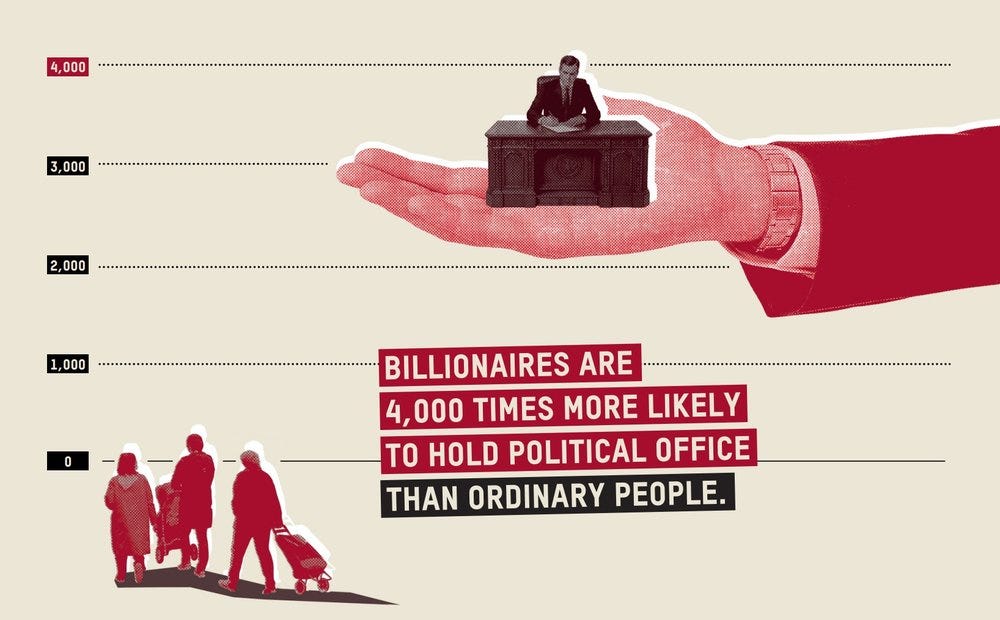
Taking a seat at the table. The super-rich are also at the forefront of political power. This is happening at local, national and global levels. A 2023 study found that over 11% of the world’s billionaires had held or sought political office. Oxfam estimates that billionaires are at least 4,000 times more likely to hold political office than ordinary people.
With every billionaire president, cabinet member and political appointee, it has become less shocking to see rich people being appointed to political positions.
Driving an anti-rights agenda. A network of far-right and conservative forces, allied with billionaires, is accused of driving a backlash against human rights and progressive policies and ideas. One way they are doing this is through funding far-right groups and political parties. According to Global Philanthropy Project, in 2021 to 2022 the income of just three anti-LGBTQI+ organizations was greater than more than 8,000 LGBTQI+ organizations globally in the same time period.
Political poverty. People living in poverty lack the time and money to participate fully in political life and face bureaucratic hurdles. Women, in particular, experience acute time poverty because of the unequal care responsibilities they face.
In low-income countries 45% of people in the least wealthy quintile lack ID, which is often a prerequisite for voting. In the US during the 2016 presidential elections, voters in Black neighbourhoods waited 29% longer to vote than those in white neighbourhoods.
Protests against inequality. In the last twelve months, over 142 significant anti-government protests have erupted worldwide. One global study of protests between 2006 and 2020 identifies failures of political representation as the largest driver of dissent, and economic justice – including inequality and austerity – as the second.
We’ve covered the youth-led protests that erupted in Kenya against IMF-imposed austerity measures extensively.


The economic and political power of the rich can be cut down to size. And the majority can take back political power, force government action to end economic inequality, and build a fairer and more sustainable future for all.
Read the full Oxfam report here.
Something to listen to
Listen to this week’s Equals episode, where we speak with three activists from Kenya, Nepal, and France who explain what drove them to the streets to fight for their cause and the brutal violence they met from the state.
