


Soaring energy prices due to the Iran war mean a new round of profiting from pain by some of the world’s largest corporates. Oxfam’s research back in 2023 found that mega-corporations raked in $1 trillion a year in windfall profits in 2021 and 2022. Unless Governments learn from the recent crises, corporations will yet again be plundering people under the cover of war.
You’d think that the argument for phasing out fossil fuels couldn’t be stronger right now. Beyond the devastation global warming is bringing the planet, there is a clear case for renewables providing energy security. But instead, the dominant narrative, pushed by fossil fuel interests, seems to be to drill for more oil and gas.
As governments convene in Santa Marta as part of a collation of the willing to phase out fossil fuels, this week’s Bulletin looks at how oil and gas companies are profiting from the current crisis.

Big oil profits, in numbers
Six oil giants are on track to earn nearly $3,000 every second in 2026. Using consensus estimates, which is the average of the forecasts that financial analysis make, the Big 6 oil companies are on track to make a combined $94 billion, which is enough to provide solar power for the energy needs of almost 50 million people in Africa.
Dividends of war. The fossil fuel business was already making rich shareholders a nice return and the disruption caused by war is estimated to add $13 billion to their profits – a 17% increase compared to 2025.

While families suffer. Food and energy price increases hit the worst off the hardest. People in the poorest countries spend 2.4 times more on food as a proportion of their income than people in high-income countries. The UN estimate that the war could push 30 million people into poverty.
Public support for change. While right-wing politicians and media push to drill for more oil, the public support progressive policies. In an Oxfam commissioned survey across seven countries, three times as many citizens support greater government investment in renewable energy compared to increasing fossil fuel extraction, and two thirds supported increasing taxes on the profits of large oil and gas corporations to help fund the transition to renewables.
Fossil fuel companies walking away from renewables. Just last month, ExxonMobil announced a significant reduction of a third of its planned investment in low-carbon energy projects and TotalEnergies refused to adopt a net zero transition plan aligned with 1.5 degrees.
Hope from Santa Marta? The conference comes against the backdrop what the executive director of the International Energy Agency, has called “the mother of all energy crises.” Shortages of oil and gas mean that governments aren’t only wanting to transition for climate reasons. Renewables are cheaper and more secure from geopolitical shocks than fossil fuels.
Wealthy governments still have not stepped up to provide sufficient climate financing for poorer countries to make the phase out, but Santa Marta is just the first step of the process to a just transition.
Something to read/listen to
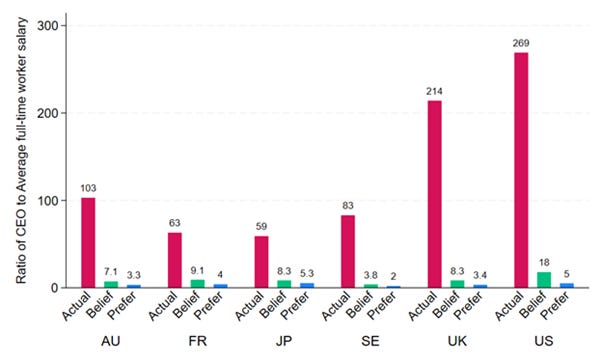
Read this new study about how people dramatically underestimate the scale of wage inequality. Nearly everyone prefers lower wage inequality, including across political lines. Far-right voters are those most affected when presented with facts around inequality.
Here is a mind-blowing graph from the study showing the gap between what people believe and the actual ratio of CEO to worker wages.
Read about the California billionaire tax proposal that will go to the ballot.
The Equals Bulletin has been on a short break but the latest season of the Equals Podcast has been in full swing. Catch up with the latest episodes:


