


Last week saw the release of the ‘Global Justice Report’ by the team at the World Inequality Lab in Paris. We cannot resist the lure of alliteration, but this was not just the work of Thomas Piketty but clearly a massive team effort, bringing together many brilliant researchers and different strands of research. It is a great report and very inspiring.
Abolishing billionaires
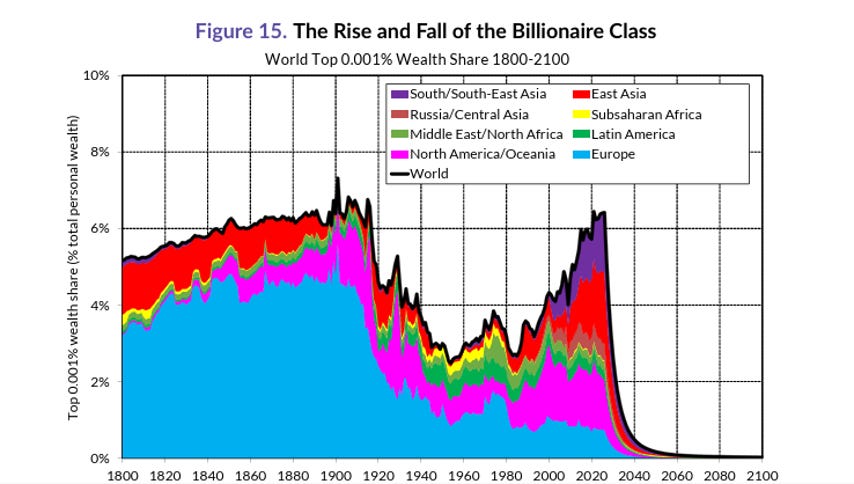
The report identifies extreme inequality and, in particular, the extreme concentration of wealth in the world as the core problem- giving too much unaccountable power to a tiny group of rich people and leaving the rest of the world impoverished. It proposes high taxes on wealth and income, not just to raise revenue, but to fundamentally reshape the economy from one based on private wealth to one based on the public good. They propose, for example, a 20% tax on billionaire wealth, which would reduce the number of billionaires to zero in a matter of decades and, in so doing, raise a huge amount of money to transform the world.
Campaigning for convergence
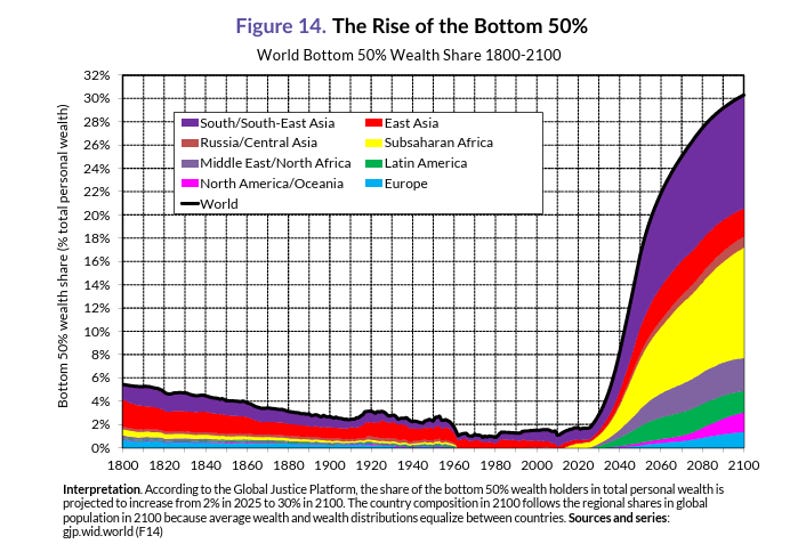
At the heart of the report is a radical and fundamental reduction in global inequality; under their plan, the gap between average incomes in the Global North and in the Global South (currently around 16 to 1) would be reduced to zero, so that average national incomes would converge on 60,000 euros per capita for every country in the world. The share of wealth held by the bottom 50% globally would rise from 2% to 30%, and the share held by the billionaire class would fall from 6% to 0.05%.
Class matters more than country
This vision is not primarily about rich nations and poor nations, though- it is fundamentally about rich people and the rest of us. At the national level, the recommendations also necessitate a dramatic compression in inequalities of income and wealth, down to a scale of 5 to 1 for income and 10 to 1 for wealth. Every country will become radically more economically equal, which will bring big benefits to the majority in rich countries too.
Only reducing inequality can deliver a future for both people and planet
Absolutely core to their vision is constructing a global economy that can deliver prosperity for all, but still achieve the rapid decarbonisation needed to keep emissions within relatively safe limits of 1.8 degrees. This is in contrast to an absolutely disastrous 4 degrees of warming that they project under current policies of persistent inequality and slow decarbonisation. Their report shows most powerfully that politically the only way to save the planet is to, at the same time, massively reduce inequality.
Not degrowth but very different growth
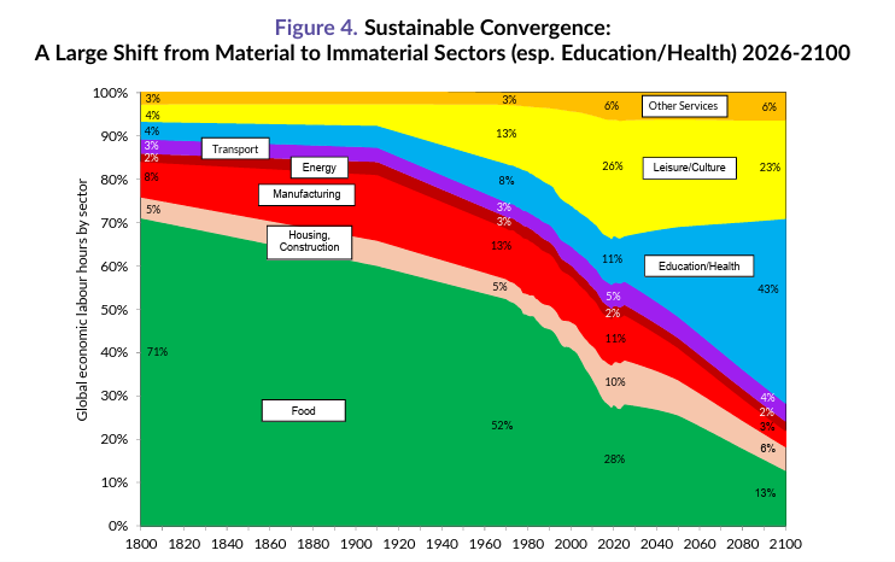
Central to this is a dramatic reshaping of the economy. They do not come out in full support of degrowth but do support dramatic degrowth in some parts of the economy. They model a huge shift from the material sectors like manufacturing and construction to more immaterial factors, with global working hours dedicated to education and health rising from 11% today to 43% by 2100. We will all work less too, with the average number of working hours halved- this labour hours reduction in turn reduces carbon emissions. We will work less but have a better life because inequality will be massively reduced, and many things like health will be decommodified, provided free and universally.
From Private Profit to Public Power- the return of public wealth
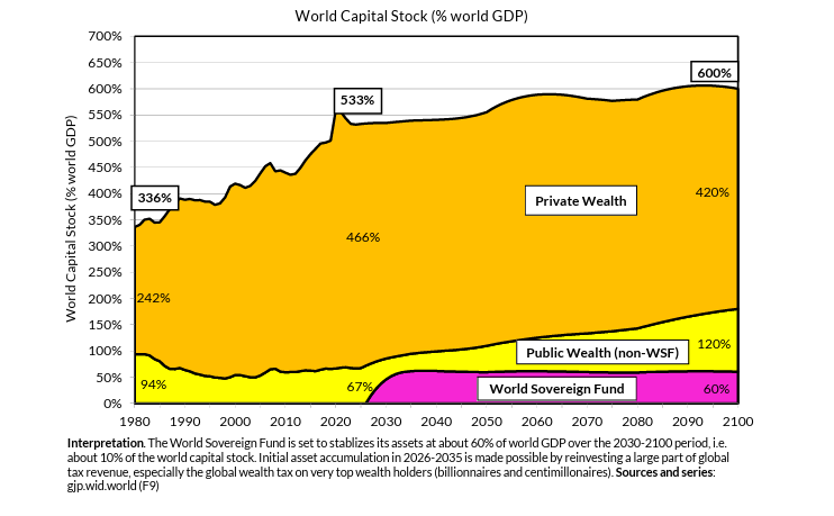
Public wealth, that is wealth held by governments, has declined sharply in recent decades. Many governments are now net debtors. This has happened as private wealth has increased rapidly. In fact, the two things are closely linked as governments took on debt and printed trillions of dollars in new money to cope with the financial crisis of 2009 and the Covid-19 calamity- this in turn has sharply increased asset prices and private wealth. The Piketty Plan will see public wealth return to being 30% of total wealth, as it was around 1980. This is critical, as public wealth can be deployed democratically to transform the way things work deliberately, unlike private wealth, where profit is the only real incentive.
(Almost) everyone will benefit
All this means that 89% of the world will see their incomes double by 2100, with 95% gaining in the Global South and 85-95% in the Global North. When the benefits of greater leisure time and a rescued and revived planet are considered, over 99% of humanity will be better off.
A Global Justice Fund
The huge investment this will require will be paid by taxing the world's super-rich and using this to capitalise a new ‘Global Justice Fund’ which would reach 10.3% of world GDP on average. This would be a new global institution; one they propose would be ruled by a democratic system of double majority; all decisions would be approved by 55% of countries representing 60% of the world’s population. This will replace the ‘Global Plutocracy’ of the IMF and World Bank, where it is one dollar, one vote.
Want to pay for that in Euros, or in UN’s?
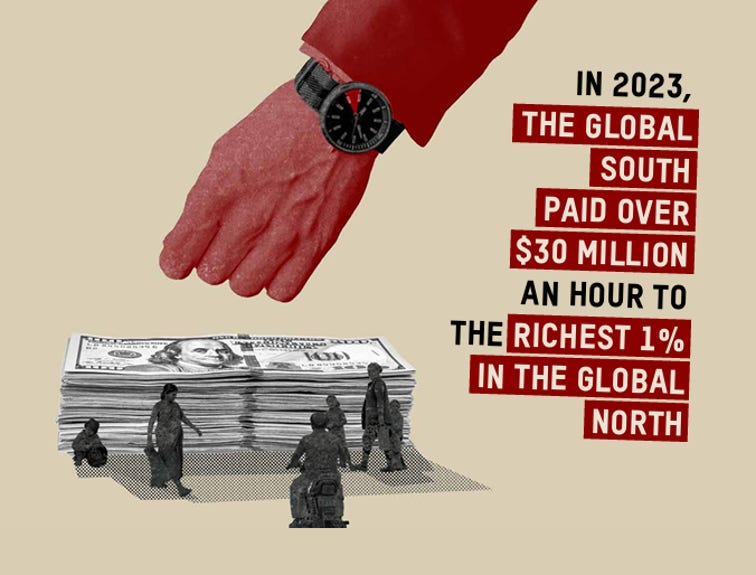
They also propose a new UN currency, which could be used by countries as their reserve currency, instead of the dollar and other ‘hard currencies’ like the euro, used today. At the moment, this gives the countries with those currencies a huge structural advantage, as they can borrow at much lower rates. It also leads to very large global economic imbalances, with a trillion dollars each year moving from south to north, and to the richest 1% in the global north in particular. Whilst they are most in favour of raising resources from taxing the global super-rich, further money could then also be raised to support the transformation by issuing the UN Currency, similar to the IMF’s Special Drawing Rights.
An equally divided pie in the sky?
Maybe, but they do lay out ways this plan could begin to happen politically, even if the world’s biggest economies refuse to take part. They point to similar radical, but peaceful reductions in inequality in many countries in the past. But political feasibility is not the main aim of this report. Instead, it is to describe, with concrete numbers and analysis, what a radically equal and climate breakdown-beating future could look like. In doing so, it is very successful. Ideas and visions of a positive future are vital to mobilise. We need things to fight for, and not just fight against, and the Piketty Plan is certainly one worth fighting for.
Something to read/listen to

Read Branko’s new research on how the share of capital income – “unearned income” that does not require working – has increased in most countries.
Read about The Roadmap for Eradicating Poverty Beyond Growth from the UN rapporteur De Shutter.
But then people get all freaked out when we talk about marxism and communism… 🤷🏻♂️
The future belongs to the proletariat, we should accept and embrace this for the sake of mankind.