


Happy (???) New Year from the Equals team. We’re only just off the back of Negotiation November, and we’re jumpstarting January with climate justice.
Our friends at the UK’s High Pay Centre are famous for their annual Fat Cat Day; this year, it took just two days for the average FTSE 100 CEO to make what the average UK worker will make all year.
We shamelessly pinched this idea to create Pollutocrat Day, the moment when the richest 1% use up their carbon budget. This is the amount of CO2 that can be emitted while staying within 1.5 degrees of warming. Just 10 days into the New Year, and we’ve already hit that moment!
Pollutocrat day…in numbers
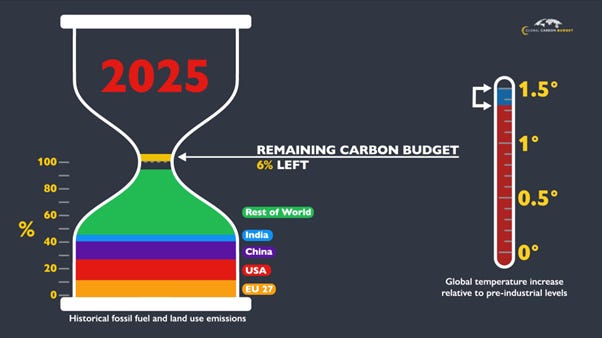
The carbon budget. There is very little of it remaining CO2 that can be emitted while staying within 1.5 degrees of warming. At current rates, there’s a good chance that the budget will be used up in just a couple of years.
The richest are blowing through the carbon budget. The 2030 emissions level compatible with 1.5 °C is 17.8 GtCO2. Divide that by 8.5 billion people (the projected global population in 2030), and you get an approximate per-person annual carbon budget of 2.1 tonnes CO2. Given that the richest 1% emit about 200 kg per day, this means their share of the budget is gone in 10 days. The top 0.1% used their budget by the 3rd January.
In contrast, someone in the bottom 50% emits less than 800kg of CO2 per year, meaning they use the annual carbon budget every 2.6 years.
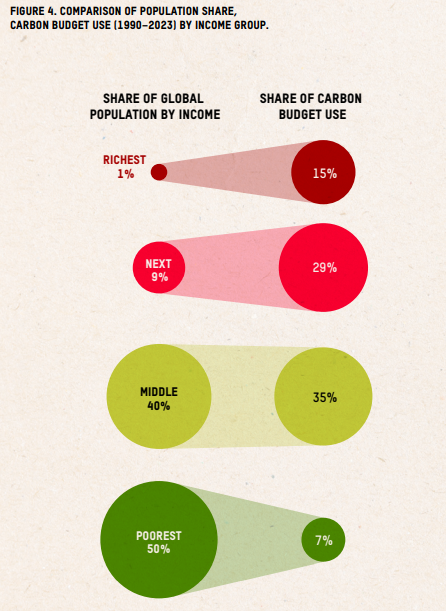
A fair share? Given that this 2.1 tonnes per person divides emissions equally among all individuals, it would be reasonable to question whether this is a fair way of sharing the budget. A fair share should really incorporate considerations of historical emissions and capacity to act, meaning the budget of the richest should be even lower and the poorest higher.
Climate inequality kills. The emissions generated by the richest 1% in one year alone are estimated to cause 1.3 million heat-related deaths by the end of the century. Decades of overconsumption by the world’s super-rich are also causing significant economic damage to low and lower-middle-income countries, which could add up to $44 trillion by 2050.
Deep cuts needed. To stay within the 1.5 degrees limit, by 2030, the richest 10% would have to slash their emissions by 90%, the 1% by 97%, and the 0.1% by 99%. On the other hand, the poorest 50% could increase their emissions by 63% to reach 2.1 tonnes CO2 per year.
Yet, one of the most shocking findings of our latest research is that the wrong group are cutting emissions. Since 1990, the richest 0.1% have increased their share of total emissions by 32%, whilst the poorest half of humanity has actually seen their share of emissions fall by 3%.
Not just direct emissions. Our Climate Plunder report makes it crystal clear - a powerful few use their economic and political influence to lock the world into disaster. They riddle negotiation spaces like COP with their lobbyists, sue governments for doing the right thing, spread climate disinformation, and finance hate to promote their fossil fuel interests. Their investments are financing the climate breakdown, with almost 60% of the billionaire investments classified as being in high climate-impact sectors, such as mining or oil and gas companies.
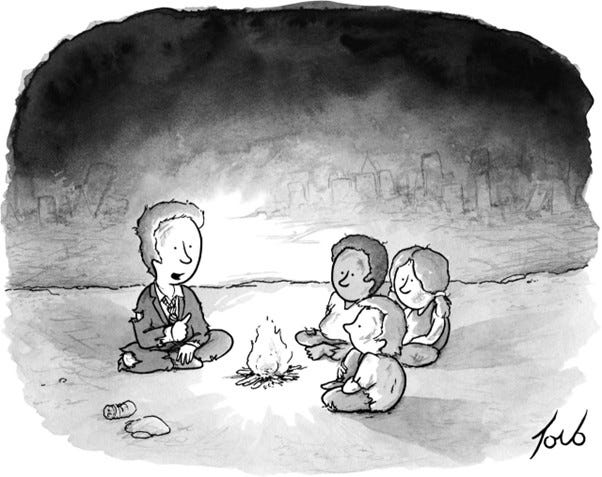
“Yes, the planet got destroyed. But for a beautiful moment in time we created a lot of value for shareholders.”
Something to read and listen to
Listen to the latest Equals Podcast with Thomas Piketty on The Great Global Wealth Transfer
Read that billionaire Jensen Huang Says He’s ‘Perfectly Fine’ With California’s Billionaire Tax.
Listen to Why Economists Should Care About Inequality, with Branko Milanovic.