The 2026 Annual Meeting of the International Monetary Fund (IMF) takes place in Bangkok, Thailand next week. Already, their Chief, Kristalina Georgieva, is urging a return to austerity. For 25 countries, this isn’t a suggestion but a demand.
What’s even more worrying is the IMF recommendation of “frontloaded fiscal adjustment”, a euphemism for returning to the dark days of shock therapy.
In this week’s Bulletin we look at new Oxfam analysis of IMF-required austerity cuts. In the next edition we’ll be looking at how those cuts are hitting the countries that are most vulnerable to the impacts of the war against Iran.
IMF austerity is back…in numbers
Austerity is back. Oxfam analysed the requirements set out for the 54 countries with IMF programs between 2019-2025. It found that nearly 25 of them were required to cut public spending by more than 2 percent of GDP over the course of their program. This is a stark increase compared to 2012 and 2017 where one-third of countries were required to make cuts.
Deep spending cuts. The median annual IMF-required “budget-balance targets”, banker speak for austerity cuts, increased from 0.21 percent of GDP between 2012 and 2017 to 0.85 percent of GDP between 2018 and 2025, a four-fold increase.
Shock-therapy is back. There are huge fears among civil society that what the IMF call “frontloaded fiscal adjustment”, banker speak for massive spending cuts imposed all at once, could be step back towards the dark era shock therapy.
Already low public spending. Low-income countries spend on average 0.8 percent of GDP on social protection, while spending on education remains below 4 percent of GDP.
Cutting away the safety net. The IMF has typically relied on “social spending floors”, banker speak for a spending safety net against their austerity. While more programs now include these floors, the protection they offer is shrinking. The median IMF-required social spending floor fell from 25 percent of current spending between 2012 and 2017, to 11 percent between 2018 and 2025.
Enough wealth to go around. In light of this, McKinsey’s latest global balance sheet of the world’s wealth is jarring. The world’s wealth stood at $1.8 quadrillion (that’s the one after a trillion) in 2025, up from $1.7 quadrillion in 2024. Global household wealth growth rose to a new high of $570 trillion, most of which is held in shares of corporations, which in turn are mostly held by the very richest in society.
Give me hope! Youth led ‘Gen-Z’ protests continue to sweep the world demanding better funding for health and education. Battles for progressive wealth taxes, like those being fought in California, are more important than ever.
We’re winning the fight to tax the super-rich

Something is changing. At Oxfam, we started banging on about the need to tax the super-rich many years ago. Sometimes it felt a bit lonely.
Something to read/listen to/attend
Watch this amazing short film on Al Jazeera ‘The Meeting That Terrified The Superpowers’ on the Bandung conference of 1955, and why it matters today in the fight against inequality and in our world of geopolitical rupture.
Read Stiglitz making the case for the International Panel on Inequality
Watch the Walrus Talk on the Billionaire Problem.
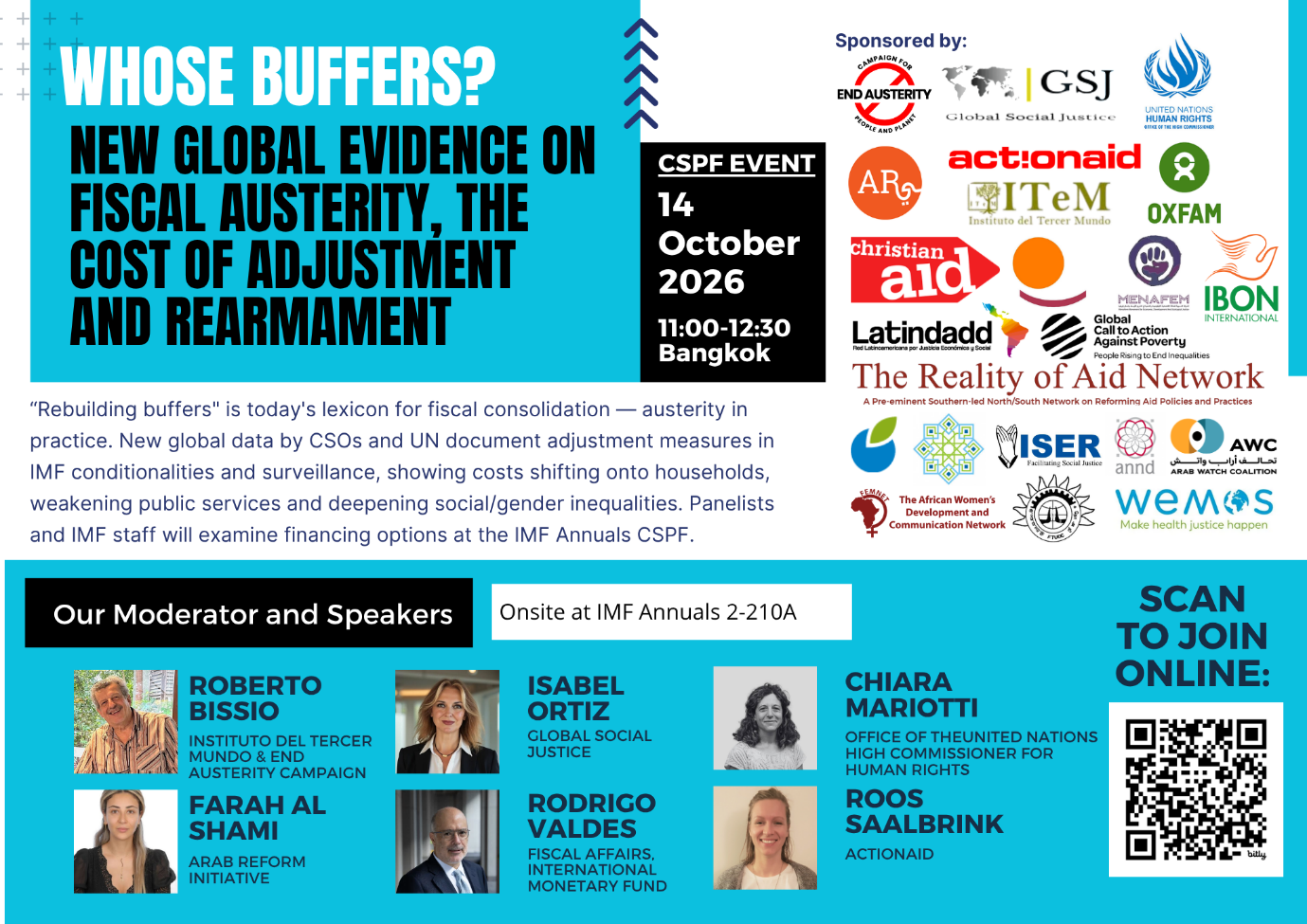
Attend this event on austerity at the IMF next week (online available)